
Published June 10, 2026 | By HDPTH Technical Editorial Team
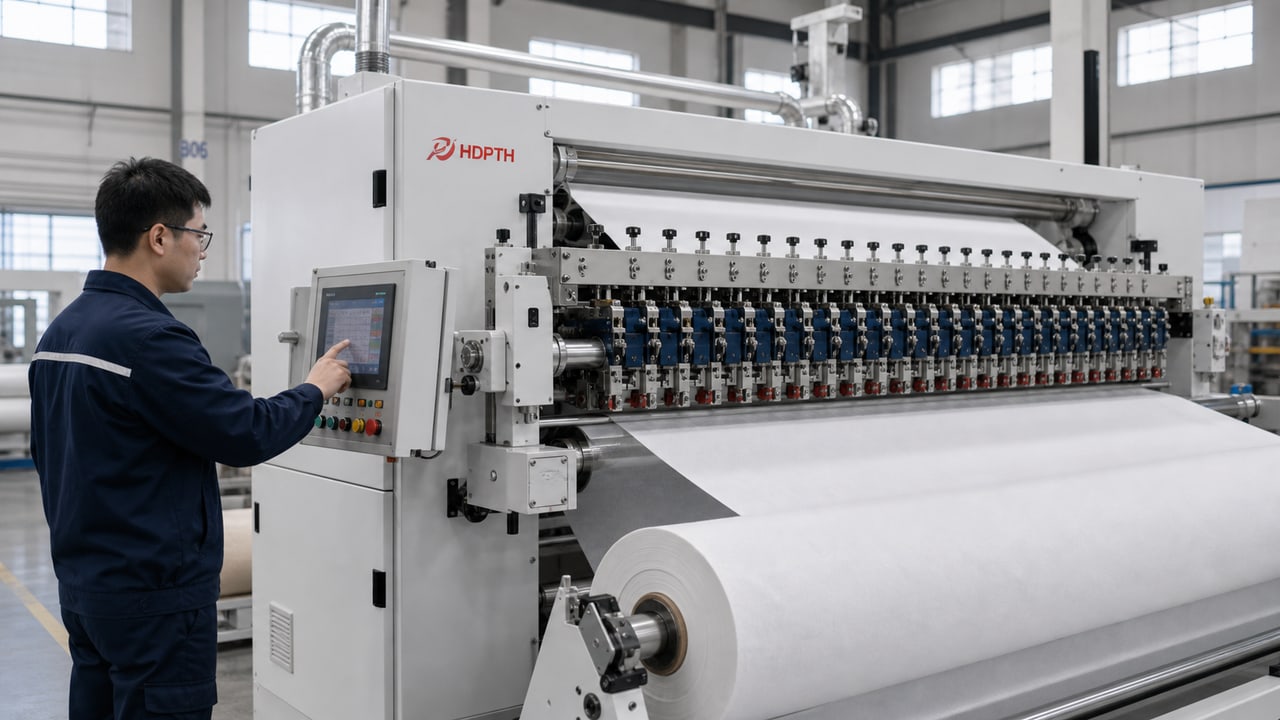
For plant managers and overseas factory owners, minimizing equipment downtime during job changeovers is critical to maximizing output. When configuring slitter rewinders, a key engineering decision is whether to rely on traditional manual knife setup or implement an automatic knife positioning system. Operating from a 6,000 m2 manufacturing base, HDPTH engineers high-speed slitting machines, nonwoven rewinding machines, and automatic knife systems designed to solve modern production bottlenecks. For converters handling diverse flexible substrates, moving away from manual blade adjustments is a strategic step toward ensuring precision and maintaining operational efficiency at scale.
Identifying the Need for Automated Positioning
Procurement managers and production engineers must weigh the operational limits of manual setups against production demands. Manual knife positioning often introduces extended downtime and variability, particularly in facilities that run multiple product sizes in a single shift. In contrast, an automated approach provides full-servo PLC high-end control technology to eliminate operator guesswork.
This transition is particularly useful for converters in the hygiene, medical, paper, and film industries. Because automatic systems can be specified as a new line component or retrofitted as an upgrade requirement, facilities have multiple pathways to achieve stable long-term operation.
Manual vs Automatic Knife Setup: Where the Real Difference Appears
The contrast between manual and automatic knife setup becomes most apparent during format changes and continuous production runs. Manual adjustments require operators to physically measure, unlock, move, and secure individual blades across an effective winding width that can span up to 4500 mm. This manual intervention inherently introduces the risk of human error, micro-misalignments, and extended machine downtime.
In contrast, automatic knife positioning systems use full-servo PLC high-end control technology to index blades to exact coordinates programmatically. The real difference appears in the ability to achieve repeatable knife positioning instantly, transforming a labor-intensive physical calibration process into a streamlined digital command that supports stable long-term operation and prevents width drift.
When Manual Knife Setup May Still Be Reasonable
Despite the technical advantages of automation, there are specific production environments where manual knife setups remain a practical engineering choice. If a flexible material converter operates a dedicated line that continuously runs a single, uniform product width and rarely requires blade repositioning, the demand for faster setup times is limited.
In these highly static applications, a manual slitter rewinder can adequately process master rolls without the added complexity of automated positioning. However, if a production manager expects multiple product dimensions, diverse materials, or frequent narrow-width setups, the manual baseline can quickly become a significant operational bottleneck.
Equipment Specifications Checklist
When evaluating an upgrade, it is necessary to match the machine's capabilities with your material and volume requirements. HDPTH automatic knife systems and related slitting lines support the following reference parameters drawn from the current product information.
| Item | Reference parameter | Buyer relevance |
|---|---|---|
| Production speed | 500-1200 m/min | Helps define whether the line matches throughput targets. |
| Effective winding width | 1500-4500 mm | Indicates the range of master-roll formats the line can address. |
| Minimum slitting width | 45-65 mm | Important for converters planning narrower finished-roll formats. |
| Control infrastructure | Full-servo PLC high-end control technology | Supports repeatable positioning and more stable setup control. |
| Waste management | Trimming recovery system / edge material recovery | Relevant when continuous production requires organized trim handling. |
| Compatible materials | Nonwoven fabric, PE film, paper, hot air, spunlace, spunbond | Useful for plants converting multiple flexible substrates. |
Operational Advantages of Automatic Knife Systems
For production managers overseeing complex runs, the transition from manual setups to automated systems directly addresses bottlenecks in flexible material converting. Manual adjustments demand significant machine downtime and rely heavily on operator skill to ensure accuracy. By using full-servo PLC high-end control technology, an automatic knife positioning system removes this variability.
This results in faster setup times between product changeovers and supports stable long-term operation, allowing operators to focus on quality control rather than repeated mechanical calibration. For buyers comparing equipment proposals, this is often the clearest distinction between a line built for repeated changeovers and a line intended for more static production.
Material-Specific Performance and Waste Management
Converters in the hygiene, medical, paper, and film sectors must process a diverse range of substrates without compromising web integrity. HDPTH automatic systems are engineered to handle demanding materials, including nonwoven fabric, PE film, paper, hot air, spunlace, and spunbond. This makes the technology relevant not only for one material family, but also for plants that move between product programs.
Pairing these automated positioning systems with a trimming recovery system or edge material recovery setup helps keep waste handling organized during continuous production. That detail matters when a buyer is evaluating whether automation solves only knife positioning or also supports cleaner, more controlled operation across the full converting process.
Explore HDPTH Upgrades and New Lines
Whether you are expanding your plant with a new high-speed slitting machine or seeking an upgrade requirement for your current nonwoven rewinding machines, automated precision can streamline your facility. Reach out to the HDPTH team to discuss integrating automatic knife systems into your flexible material converting lines.
Discuss Your ConfigurationChoosing Between New Lines and Equipment Upgrades
Engineers and plant managers do not always need to invest in entirely new infrastructure to benefit from automated positioning. HDPTH automatic knife systems are designed with integration flexibility in mind. They can be specified as a core component of a brand-new high-speed slitting machine or evaluated as an upgrade requirement for existing nonwoven rewinding machines.
This adaptability allows factory owners to phase capital expenditure while still modernizing production floors. For overseas buyers, that distinction is useful during budgeting because it separates the question of whether automation is needed from the question of how broadly the line must be rebuilt to support it.
What RFQ Data a Supplier Needs Before Recommending Automatic Positioning
To engineer an accurate machine configuration, procurement managers and plant engineers must provide specific production data during the RFQ process. A supplier needs to understand the full scope of the targeted substrates, including whether the line will process nonwoven fabric, PE film, paper, hot air, spunlace, or spunbond.
The RFQ should clearly state the required minimum slitting width and the maximum effective winding width for the facility's largest master rolls. Production engineers should also specify the target operating speed, such as the 500-1200 m/min reference range, and clarify whether the automatic knife system is being sourced as a new line component or must be integrated as an upgrade requirement for existing equipment.
- Material family and substrate details for each planned product line
- Parent-roll width, finished slit-width plan, and any narrow-width requirement
- Target speed range and expected production pattern across shifts
- Whether the request is for a new line or a retrofit to an installed machine
- Waste-handling expectations, including trim and edge-material recovery
What to Review During Technical Evaluation Before Order
Before finalizing an order, technical teams and factory owners should evaluate the proposed equipment specifications against their specific converting requirements. Engineers should review the architecture of the full-servo PLC high-end control technology to confirm it can deliver repeatable knife positioning and stable long-term operation under continuous load.
It is also necessary to assess the waste-management components, making sure that the trimming recovery system or edge material recovery setup is suitable for continuous operation at high speeds. Finally, checking the supplier's production environment, such as HDPTH's documented 6,000 m2 manufacturing base, helps buyers confirm that the vendor has the industrial capacity to build and deliver complex automated slitting equipment.
Achieving Repeatable Precision at Scale
Whether operating a new line or an upgraded rewinder, maintaining exact dimensions across large rolls is critical. Automated systems support repeatable knife positioning so that each run can match the required slit-width pattern more consistently. This matters most when a plant needs to move between specifications without turning every changeover into a manual measuring exercise.
With the capability to achieve a minimum slitting width of 45-65 mm across an effective winding width of 1500-4500 mm, and at production speeds ranging from 500 to 1200 m/min, the technology supports both higher-volume output and stricter dimensional control. For the buyer, the issue is not only speed, but whether that speed can be maintained while preserving configuration repeatability.
Buyer FAQs
What materials can be processed using HDPTH automatic knife systems?
The systems are designed for flexible material converters and reliably process nonwoven fabric, PE film, paper, hot air, spunlace, and spunbond.
What are the speed and width capabilities of the automatic row knife slitting machine?
HDPTH machines support continuous production speeds of 500-1200 m/min and an effective winding width of 1500-4500 mm.
Can automatic knife positioning be added to our existing machinery?
Yes. These systems can be implemented either as a new line component or as an upgrade requirement for current nonwoven rewinding machines and slitter rewinders.
How narrow can the automated system slit materials?
The automatic knife systems offer repeatable knife positioning to achieve a minimum slitting width of 45-65 mm.
What control technology drives the automatic knife positioning?
The systems use full-servo PLC high-end control technology to support faster setup times, precise blade placement, and stable long-term operation.
Ready to Optimize Your Slitting Operations?
Eliminate the downtime and variability of manual knife setups. Whether you are engineering a new production line or seeking a critical upgrade requirement for your current equipment, HDPTH can review your material, width, speed, and line-configuration requirements before quotation.
Send Your RFQ