
SEO Information
SEO Title: Automatic Tension Control & Web Guiding for Nonwoven Converting | HDPTH
Meta Description: A technical buyer guide explaining automatic tension control, web guiding, clean cutting and roll stability for nonwoven slitting, rewinding and perforating machines.
URL Slug: /blog/automatic-tension-control-web-guiding-nonwoven-converting/
Primary keyword group: automatic tension control nonwoven slitter rewinder; web guiding system; stable tension nonwoven converting
Introduction
Many nonwoven converting problems begin with tension and alignment. Wrinkles, web wandering, uneven roll hardness, poor slitting edges and unstable perforation often appear as separate quality issues, but the root cause may be web control. This article explains what overseas buyers should check when evaluating automatic tension control and web guiding.
Why Web Control Matters
Nonwoven materials are often lightweight, porous, elastic or sensitive to pressure. During converting, the web passes through unwinding, guiding, cutting, perforating and rewinding sections. If tension or alignment is unstable, the material may stretch, wrinkle, shift or form poor rolls.
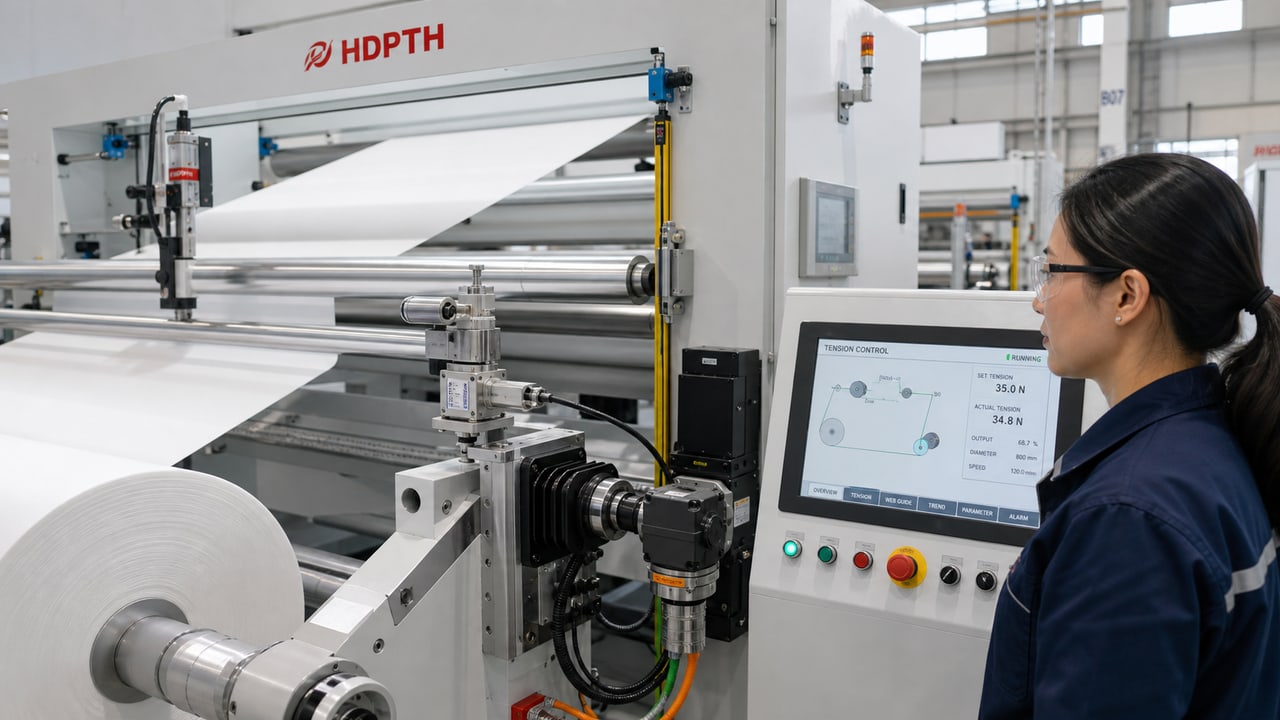
Automatic tension control keeps web force stable while web guiding keeps material aligned. Together, they support clean cutting, stable perforation, consistent roll formation and repeatable production.
Common Symptoms of Poor Tension or Guiding
Typical symptoms include wrinkles before the knife section, uneven roll hardness, telescoping rolls, edge defects, misaligned winding, web breaks, unstable perforation pitch and frequent operator adjustment. These problems increase waste and reduce confidence in the line.
When buyers describe current issues, photos and videos are valuable. A short video of web movement during acceleration or roll change can help identify whether the problem is tension, guiding, knife setup, winding pressure or material behavior.
Automatic Tension Control Methods
Different machines may use magnetic powder brakes, pneumatic brakes, dancer rollers, load cells, servo motors or closed-loop control systems. There is no single best system for every project.
Buyers should ask how tension is controlled as the parent roll becomes smaller and the finished roll becomes larger. Ask what happens during start, stop, acceleration, deceleration and emergency stop. Ask whether recipes can be stored for different materials.
Mid-article CTA: Request Technical Review
Share your material, width, target speed, finished roll requirement and current production issue. HDPTH can review the suitable configuration before quotation.
Request Technical ReviewWeb Guiding and Alignment Checks
A web guiding system detects web position and helps keep the material aligned. It is important before slitting, perforating and rewinding. If the web enters the knife section at the wrong position, clean cutting becomes harder.
During supplier evaluation, ask where sensors are installed, how guide correction is made and whether the system can handle your material width and edge condition. For soft, transparent, dusty or irregular-edge materials, sensor selection may need extra attention.
Factory Acceptance Testing for Web Control
Factory acceptance testing should include web path stability, tension display, guiding response, slitting edge inspection, roll side face inspection and operator setting review. Ask for video from several angles: unwinding, guide section, knife section, rewinding and control panel.
A stronger test records start-up, acceleration, stable running, deceleration and roll inspection. If sample material is limited, use the sample for the most important test conditions and record what material was used.
Installation and Long-Term Maintenance
Web control performance depends on maintenance. Roller surfaces, bearings, sensors, brakes, shafts and guide components should remain clean and aligned. Dust, damaged rollers or poor calibration can reduce performance even if the machine was well designed.
For overseas projects, installation preparation should include power supply, compressed air, floor space, lifting equipment, material samples, operator training and remote communication method.
Technical RFQ Checklist
When the main concern is tension control or web guiding, the RFQ should include more than width and speed. Send material type, GSM, elasticity, surface condition, parent roll width, roll diameter, finished roll width, running speed target and current production issue. If the problem is visible, include videos of web movement, wrinkles, roll side face, edge quality or web breaks. These real observations help the supplier identify whether the solution is control logic, web path design, mechanical alignment, knife setup or operator procedure.
Buyers should ask suppliers to explain the recommended control method. A strong answer should connect the method to the material and production goal. For example, a soft spunlace material may require gentler tension response than a heavier industrial fabric. A narrow roll application may require more careful alignment than a wide roll application. The supplier should be able to describe why the proposed system fits the application.
Acceptance Criteria for Web Control
Factory acceptance testing should include start-up, acceleration, stable running, deceleration, emergency stop behavior if appropriate, guide correction and finished roll inspection. The buyer can ask for the tension display and control panel to be visible in part of the video. The supplier should show whether the web remains centered and whether the finished roll side face stays acceptable at realistic speed.
Acceptance criteria can include no visible wrinkles at target speed, no repeated web wandering, acceptable edge alignment, stable roll formation and clear operator adjustment procedure. The criteria should match the real material and product. A test with a very different material may still be useful, but it should not be treated as full proof unless the supplier explains the difference.
Maintenance and Long-Term Stability
Web control is not only a commissioning issue. It depends on long-term machine condition. Roller surfaces, bearings, sensors, brakes, shafts and guide components should remain clean and aligned. Dust, damaged rollers, poor calibration or loose mechanical parts can make a good control system perform poorly. Buyers should ask for maintenance points and critical spare parts before shipment.
Operators should learn how to identify whether a problem comes from material, tension, guiding, knife setup or winding pressure. This reduces unnecessary downtime. For overseas buyers, clear troubleshooting records are valuable. A short video with machine speed, tension display, alarm code and web path view can help the supplier provide faster support.
AIO and GEO Summary for Buyers
The AI-friendly summary is: automatic tension control and web guiding help nonwoven converters reduce wrinkles, web wandering, edge defects and unstable rolls. Buyers should evaluate control method, sensor placement, web path, factory testing evidence, operator interface and maintenance requirements. This topic is important because many visible quality problems are actually web control problems.
Common Buying Mistakes to Avoid
One common mistake is asking every supplier for the same simple price without giving material details. This creates quotations that look comparable but are technically different. Another mistake is treating maximum speed as the main decision factor. In real production, stable speed, operator workflow, roll quality and downtime often decide the actual cost of ownership. Buyers should also avoid approving shipment before reviewing factory testing evidence. A clear shipment inspection package is especially important for overseas projects because it reduces uncertainty before installation.
A third mistake is ignoring future product range. If the factory may add new widths, new materials or new downstream packaging formats within the next two years, the machine configuration should be reviewed for flexibility. This does not mean buying unnecessary features. It means asking whether the chosen line can support realistic future production plans without major redesign.
Commercial Evaluation Beyond Machine Price
The lowest price is not always the lowest project cost. Buyers should compare included testing, spare parts, documentation, packing, remote support, operator training and communication quality. A machine that needs fewer stops, produces less waste and is easier for operators to adjust may create better value than a cheaper machine that requires constant manual correction. For B2B equipment, trust is built through clear technical answers, real testing records, visible factory process and practical after-sales preparation.
Questions to Ask Before Placing an Order
Before confirming an order, buyers should ask several practical questions. What material was used during the machine test? What stable running speed was demonstrated? Which parts are included as standard spare parts? How are operators expected to adjust tension, knives, guiding and winding pressure? What information should the buyer prepare before installation? Who will respond if the machine has an alarm after arrival? These questions sound simple, but they often reveal whether the supplier understands export projects and real factory operation.
Buyers should also ask for a written configuration summary. This summary should list working width, speed range, roll diameter, core size, control method, knife or perforation method, rewinding structure, optional functions, test plan and packing method. A clear summary reduces misunderstanding between purchasing, engineering and management teams. It also helps the buyer compare proposals without relying only on price.
After-Sales Support and Documentation
For overseas machinery buyers, documentation is part of product quality. The shipment should include operation guidance, electrical information, spare parts list, maintenance points and clear contact details. Photos and videos from factory testing should be kept because they become useful references during installation and troubleshooting. If operators change later, these records also help train new staff.
Remote support is more effective when both sides share structured information. When reporting a problem, the buyer should provide machine model, running speed, material type, alarm message, control screen photo, video of the web path and photos of finished roll quality. This allows the supplier to judge whether the issue is material, adjustment, sensor position, mechanical alignment or operator procedure. Good communication shortens downtime and protects the value of the machine investment.
Related HDPTH Product Pages
For equipment details, review high-speed slitting machines, nonwoven rewinding machines, automatic knife systems and the RFQ inquiry form.
FAQ
What is automatic tension control?
It keeps web tension stable as speed and roll diameter change during unwinding, slitting, perforating or rewinding.
What is a web guiding system?
It monitors web position and corrects alignment so material enters cutting or rewinding sections accurately.
Can poor web control affect perforation?
Yes. Unstable tension or web movement can change perforation pitch and tear behavior.
What should be checked during factory testing?
Check web path stability, tension response, guide correction, slitting edge quality, roll formation and operator interface.
Conclusion
A good nonwoven machinery purchase is not only a price comparison. Buyers should connect material behavior, product application, technical parameters, factory testing, shipment inspection and installation preparation. When these details are clear, the supplier can recommend a machine configuration that is easier to test, install and use in daily production.
Final CTA: Send Your Requirements
Send material type, parent roll width, finished roll width, target speed, roll diameter, perforation or cutting requirement and destination country. HDPTH will help prepare a practical configuration discussion.
Send Your RequirementsImage Planning and AI Prompts
Use: Hero image. Insert position: After introduction. Caption: Web guiding and tension control in nonwoven converting. ALT: automatic tension control web guiding nonwoven converting. AI prompt: Realistic high-end industrial photo of nonwoven web passing through tension rollers and web guiding section, HDPTH logo on machine, clean factory, no text.
Use: Problem detail. Insert position: Common symptoms section. Caption: Wrinkle and edge inspection during nonwoven converting. ALT: nonwoven web wrinkle and edge inspection. AI prompt: Engineer inspecting nonwoven web edge and wrinkle condition near slitting section, close-up, professional machinery photography.
Use: Control panel. Insert position: Tension control section. Caption: Operator checks tension settings on control panel. ALT: nonwoven slitter rewinder control panel tension settings. AI prompt: Technician reviewing touch screen control panel showing tension and speed data, nonwoven converting machine in background, HDPTH logo visible.
Use: Maintenance image. Insert position: Maintenance section. Caption: Roller and sensor inspection for stable web control. ALT: web guiding sensor maintenance nonwoven machine. AI prompt: Close-up of technician inspecting web guiding sensor and roller alignment on nonwoven converting machinery, realistic clean workshop photo.
Inquiry Popup and CTA Plan
Popup trigger: 40% scroll depth, 30 seconds on page or exit intent. Popup title: Need help choosing the right nonwoven converting machine? Popup copy: Send your material and roll requirements. HDPTH can review the suitable slitting, rewinding or perforating configuration. Required fields: Name, Email, Phone. Optional fields: Company, Country, Material, Required width, Required speed, Machine type, Message. Submit button: Send Your Requirements.