Published June 28, 2026 | By HDPTH Technical Editorial Team
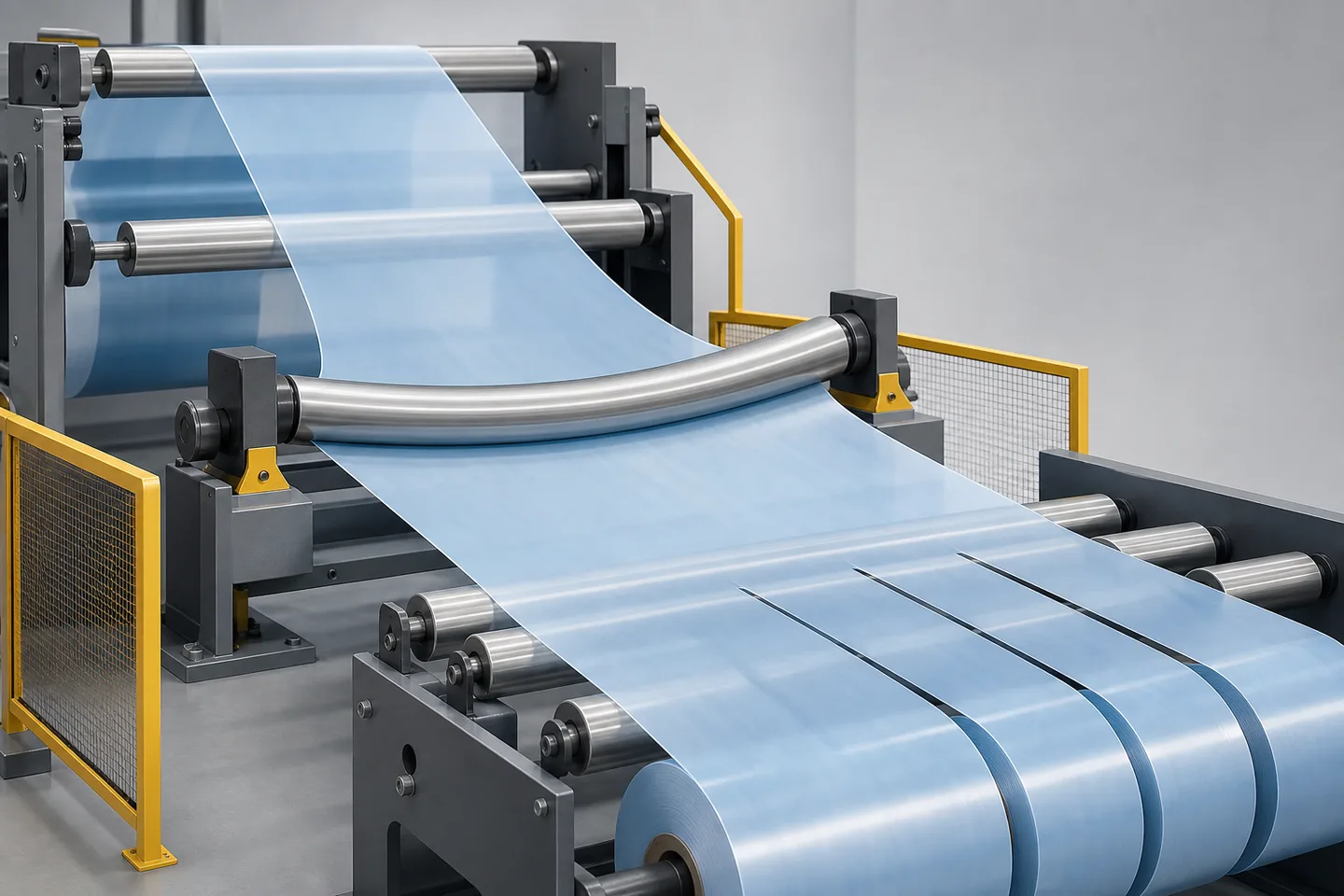
A slitter rewinder can have accurate knives, stable drives and a sound winding section yet still produce web wrinkles or lanes that move together after cutting. In those cases, buyers often hear a short recommendation: add a banana roller, bow roller or spreader roll. The names are familiar; the specification is usually not.
A bowed roll can be effective, but its performance depends on traction and geometry. Installing the wrong roll, placing it in the wrong span or applying too much bow can exchange one problem for another: distorted edges, web marking, unstable tracking or excessive stress in a light nonwoven or film.
This guide helps production managers and engineers decide whether a bowed spreader roll belongs in a new slitter rewinder RFQ, an upgrade project or a troubleshooting plan.
What a bowed spreader roll actually does
A bowed spreader roll has a curved axis covered by a rotating sleeve. As the web travels over the roll in traction, the roll's geometry creates a spreading action across the machine direction. Depending on its position, the action can flatten wrinkles in a full-width web or help create separation between lanes after slitting.
The term banana roller is commonly used for the same general device. Some suppliers distinguish among fixed-bow, adjustable-bow and other constructions. Buyers should look beyond terminology and ask how bow amount, roll orientation, covering, speed rating and mounting will be selected for the application.
Maxcess describes bowed rolls for web separation, wrinkle elimination, slack edges and soft spots. Converter Accessory Corporation explains that the web must remain in traction and that entry span, exit span and wrap angle materially affect spreading. These points matter because a spreader is not an isolated component. It works only as part of the web path.
Start with the defect, not the option
Before requesting a spreader, document where the defect begins. A wrinkle already present on the parent roll may need a different response from a wrinkle created at an idler, guide correction, nip or tension transition. Lanes that touch after the knives are also a different problem from full-width wrinkles entering the knife section.
| Observed Condition | What to Check First | Possible Spreader Role |
|---|---|---|
| Center wrinkles before slitting | Parent-roll profile, roller alignment, traction and tension | Controlled spreading before the knife section may help |
| Slit lanes overlap or interweave | Knife setup, lane path, tension and available separation span | Post-slit spreading may help keep lanes separated |
| Wrinkles appear only at higher speed | Air entrainment, roller traction, vibration and speed matching | Roll surface or driven-roll strategy may matter as much as bow |
| One edge is slack | Cross-web thickness profile, parent-roll quality and alignment | A spreader may reduce the symptom but cannot repair material profile |
| Web wanders from side to side | Web guide, sensor position, roller alignment and tension zones | A spreader is not a substitute for web guiding |
| Wrinkles begin at the rewind nip | Lay-on pressure, trapped air, winding tension and roll hardness | Review winding controls before adding upstream spreading |
Use slow-motion video and mark the first roller where the wrinkle becomes visible. Record machine speed, web tension setting, parent-roll diameter and material lot. This evidence lets a supplier discuss causes rather than guess from a finished-roll photograph.
Where the spreader sits changes what it solves
Before the slitting section
A spreader before the knives is intended to present a flatter, more stable full-width web to the cutting section. This position may be relevant when wrinkles affect slit-width consistency or edge quality. It should be evaluated with the web guide and knife-entry span because excessive correction or an unstable path can move the web laterally at the cut.
After slitting and before rewinding
After the knives, the objective may be lane separation rather than full-web flattening. Valmet describes the spreader's role in maintaining cross-machine tension so slit webs separate and wind correctly. The required action depends on lane count, slit width, web stiffness, winding geometry and the distance available before the rewind.
Near a nip or contact roll
Placement near a nip requires extra care. The exit span must preserve the spreading effect, while the web must not be distorted before entering the nip. If the reported defect is trapped air, telescoping or uneven hardness, review lay-on roller and nip pressure before assuming that more spreading is the solution.
Traction, tension and geometry must agree
A rotating bowed roll depends on traction between the web and roll surface. If the web slips, the designed spreading action weakens or becomes unpredictable. Traction changes with roll covering, dust, web surface, moisture, air carried into the wrap and operating speed.
Tension is equally important. Too little tension may not maintain traction; too much tension can damage or distort sensitive material. Valmet notes that insufficient spreading can contribute to adjacent webs rubbing, while excessive spreading can shift outer layers. The practical lesson is not to chase maximum spread. The goal is the minimum repeatable adjustment that controls the defect without damaging the web.
Entry span, exit span and wrap angle determine how the web approaches, engages and leaves the roll. Converter Accessory Corporation's technical guidance says the entry span is especially important and warns that excessive wrap can be a reason a bowed roll appears to perform poorly. A machine supplier should therefore provide a web-path drawing, not only the roll diameter and face width.
Fixed bow or adjustable bow?
A fixed-bow roll is selected for a defined application and offers a repeatable geometry. It can be a sensible choice when the plant runs a narrow material range with stable widths, tensions and speeds. The risk is limited flexibility if the product mix changes.
An adjustable-bow design gives operators or maintenance staff a way to tune spreading for different materials or lane patterns. That flexibility is useful only with controlled settings. If adjustments are undocumented, shifts may solve the same problem differently and make quality harder to reproduce.
Ask how the adjustment is made, whether the apex can be oriented, what range is available, and how settings will be recorded in recipes or work instructions. Also ask what prevents an operator from applying an excessive setting to a thin film, soft nonwoven or surface-sensitive web.
Need a web-path review before quotation?
Send HDPTH your material, web width, speed, lane pattern, wrinkle video and a simple roller-layout sketch. The inquiry can be reviewed as a complete slitting and rewinding path rather than a stand-alone roller request.
Request a Configuration ReviewMaterial-specific questions buyers should answer
Nonwoven, paper, PE/PET film and laminated webs do not respond identically. A porous nonwoven may be light, extensible and sensitive to edge stress. Thin film may carry air at speed or show surface marking. Paper may tolerate higher traction but expose sheet-profile problems. Adhesive or coated material may require a release surface and careful contamination control.
Send representative samples when possible. State whether the web is elastic, porous, dusty, abrasive, heat-sensitive, coated, printed or prone to static. Include thickness or basis weight and the acceptable surface-quality standard. The roll covering and cleaning plan should match those conditions.
HDPTH's high-speed slitting machine page lists nonwoven fabric, PE film, paper, hot-air nonwoven, spunlace and spunbond among applicable materials, with final configuration dependent on the project. Its listed effective winding-width range is 1500–4500 mm and minimum slitting width is 45–65 mm, depending on material and knife configuration. Those verified ranges describe product capability, but they do not by themselves determine whether a bowed spreader is necessary. The web defect and trial result still decide.
RFQ checklist for a bowed spreader roll
- Material name, construction, thickness or basis weight, and surface condition.
- Minimum, normal and maximum web width.
- Operating and target speed range, including acceleration conditions.
- Normal tension range and whether load-cell or dancer feedback is used.
- Knife method, lane count, slit-width pattern and minimum slit width.
- Exact wrinkle or lane-separation problem and where it first appears.
- Existing web-path drawing with roller diameters and span lengths.
- Web contact side, surface-marking limits and contamination concerns.
- Photos of parent rolls, web wrinkles, knife entry and finished roll faces.
- Videos at low, normal and problem speed with tension settings visible.
- Preferred fixed or adjustable design, if plant standards already exist.
- Cleaning access, bearing maintenance and spare-sleeve expectations.
This information also helps identify cases where the better response is roller realignment, tension-zone correction, improved web guiding or a change in the winding section. A good proposal is allowed to conclude that a bowed roller is unnecessary.
Factory acceptance testing: prove the result, not the hardware
During FAT, inspect the spreader as part of a full operating sequence. Start with the roll at a documented setting. Run representative material from start-up through acceleration, steady production speed and deceleration. Record the parent roll, web immediately before the spreader, web immediately after it, knife entry, slit-lane path and rewind rolls.
Test more than one lane pattern if the plant will run materially different jobs. A setting that works for a few wide lanes may not suit many narrow lanes. If the machine uses an adjustable bow, record the setting and repeat the run to confirm that another operator can reproduce it.
Acceptance should cover the intended outcome: no unacceptable wrinkles at the defined location, stable lane separation, no new edge damage, no surface marking, no repeated tracking correction and acceptable finished-roll faces. Agree on test material, speed, tension, slit pattern and inspection method before FAT; otherwise the parties may watch the same trial and reach different conclusions.
Review guarding and service access as well. OSHA's general machine-guarding rule identifies ingoing nip points and rotating parts as hazards requiring protection where employees can be exposed. Buyers should apply the regulations and risk-assessment process relevant to their destination country, including safe cleaning and adjustment procedures.
Shipment inspection and installation preparation
Before shipment, verify roll face condition, sleeve material, bearings, mounts, adjustment mechanism, locking devices and orientation marks. Photograph the installed position and label any parts removed for transport. Include adjustment and maintenance instructions with the machine documents.
At site, foundation level and machine alignment matter. Reconfirm the entry and exit roller geometry after assembly rather than assuming that shipping marks alone guarantee the final web path. Prepare safe access for sleeve inspection and cleaning, and keep the specified cleaning agents away from coverings they could damage.
For an upgrade, measure the available frame space and guarding clearance before manufacturing. A spreader cannot be inserted wherever a gap happens to exist; the neighboring spans must support the intended geometry and operators must be able to service the roll safely.
Common purchasing mistakes
- Adding a banana roller because a competitor's machine has one.
- Describing the symptom as “wrinkles” without showing where it starts.
- Using a spreader to mask damaged parent rolls or misaligned idlers.
- Ignoring wrap angle and span lengths in the supplier drawing.
- Choosing maximum bow instead of the minimum effective setting.
- Testing only at low speed or with a material unlike normal production.
- Failing to define acceptable marking on films and coated webs.
- Leaving sleeve wear, cleaning and bearing service out of spare-parts planning.
Buyer FAQs
What does a bowed spreader roll do on a slitter rewinder?
A bowed spreader roll creates cross-machine spreading action while the web is in traction with the roll. It can help flatten wrinkles before slitting or winding and can help keep slit lanes separated before they reach the rewind section.
Does every slitter rewinder need a bowed roller?
No. A bowed roller should solve a defined web-handling problem. If wrinkles come from poor parent-roll quality, misalignment, incorrect tension, damaged idlers or an unsuitable web path, those causes should be corrected instead of relying on more spreading force.
Where should a bowed spreader roll be installed?
Position depends on the problem. A roll before the knives may address full-width wrinkles; a roll after slitting may help separate lanes before rewinding. Entry span, exit span, wrap angle, traction and nearby nips must be reviewed as one web path.
What information should buyers send in an RFQ?
Send material, thickness or basis weight, web width, speed range, tension range, lane count, slit widths, wrinkle location, parent-roll condition, surface sensitivity, current roller layout, photos and operating videos.
How should a spreader roll be tested during FAT?
Run the buyer's representative material through start-up, acceleration, steady speed and deceleration. Record the web before and after the spreader, knife entry, lane separation and finished rolls, then verify that adjustments are repeatable without edge damage, marking or unstable tracking.
Sources
- Maxcess: WEBEX bowed rolls
- Converter Accessory Corporation: Curved-axis bowed spreader roll principles
- Valmet: Spreader roll principles, problems and solutions
- OSHA 29 CFR 1910.212: General machine guarding requirements
Ready to specify your slitter rewinder web path?
Send HDPTH the material, width, speed, lane pattern, roll requirements and evidence of the current defect. A complete RFQ helps align slitting, tension, guiding, spreading and rewinding around the same production target.
Send Your Slitter Rewinder RFQ