Published July 4, 2026 | By HDPTH Technical Editorial Team
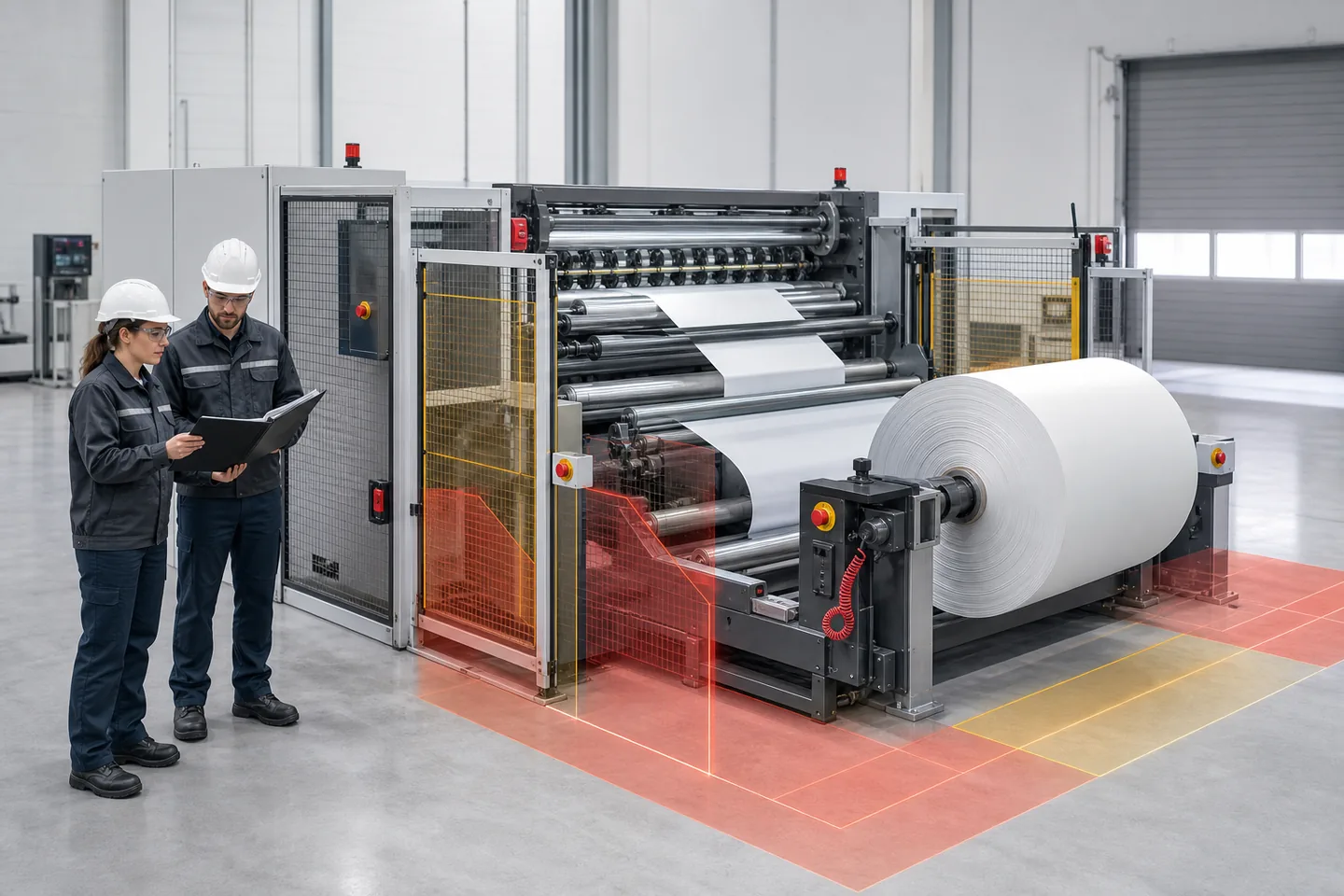
CE marking is often compressed into a single line on a quotation. That is commercially convenient but technically weak. A slitter rewinder combines powered unwind and rewind stations, driven rolls, nip points, knives, stored pneumatic or hydraulic energy, electrical controls and frequent operator access. Its conformity package therefore has to describe a real machine and its intended use, not a generic product family.
This guide is a procurement checklist, not legal advice. EU importers and users should confirm the applicable legislation, standards and national obligations with qualified machinery-safety specialists. The practical objective is to ask better questions early enough that guarding, control architecture and documentation do not become expensive shipment-stage disputes.
Know which EU machinery framework applies
As of July 2026, Directive 2006/42/EC remains the principal EU machinery framework for machines placed on the market before the transition. Regulation (EU) 2023/1230 applies from January 20, 2027 and repeals the Directive, subject to the Regulation's transitional provisions. The date is important for projects quoted now but delivered in 2027.
Do not decide the framework only from the purchase-order date. Ask the responsible economic operator or specialist to determine the relevant placing-on-the-market date and the correct declaration. The contract should say which legislation and edition of cited standards the supplier will use, how a schedule change will be handled, and who will review the final pack.
Other EU legislation may also apply to parts of the supplied system—for example electrical compatibility or equipment intended for a particular atmosphere. The machine builder should list applicable acts on the declaration rather than promising a vague “European standard.” The buyer must also disclose solvent, dust, fiber, coating and hazardous-area information that changes the assessment.
CE marking is a process, not a purchased certificate
For most machinery, the manufacturer is responsible for conformity assessment, technical documentation, instructions, the declaration and affixing the CE marking. A notified body is not automatically required for every slitter rewinder. The correct route depends on classification and applicable requirements, so procurement teams should ask the supplier to identify the route instead of demanding an unspecified third-party certificate.
The distinction matters because a test report, management-system certificate, company award or patent does not replace the machinery declaration. HDPTH's public certificates and patent records help buyers assess supplier background and documented technology, but those records should be evaluated separately from the conformity package for a specific machine.
Likewise, a CE mark on a component does not make the assembled line compliant. Drives, light curtains, emergency-stop devices and electrical enclosures can support the design, but the builder must assess how they interact in the finished slitting and rewinding system.
Documents to request before order, before FAT and before shipment
| Stage | Buyer Evidence | Why It Matters |
|---|---|---|
| Quotation review | Intended use, exclusions, applicable legislation, proposed standards and conformity route | Prevents “CE” from hiding different technical assumptions. |
| Design approval | General arrangement, guarded-zone layout, access points, safety devices, utilities and interface responsibility | Allows the plant to review workflow and integration before fabrication is fixed. |
| Pre-FAT | Draft manual, draft declaration, electrical drawings, safety-function list and FAT protocol | Gives the buyer time to find missing identifiers, options or tests. |
| Shipment release | Signed declaration, final manuals and drawings, test records, labels, serial number and document revision register | Connects the paperwork to the machine that will actually ship. |
A buyer does not necessarily receive the manufacturer's complete internal technical file. EU rules require the manufacturer to compile and retain defined technical documentation, while the commercial document pack can be narrower. Resolve that boundary in the contract. State which risk-assessment summary, calculations, safety validation evidence, component records and software backup the buyer may review or receive.
Language also belongs in the purchase specification. Identify the language required for original instructions, translated instructions, warnings and operator-interface text in the destination country. Define who controls translations and how changes after FAT will be updated across every version.
Planning a slitter rewinder for an EU plant?
Share the destination, material range, roll data, line interfaces and required document pack so compliance-related scope can be discussed with the machine configuration.
Send Project RequirementsStart the risk review with actual converting tasks
ISO 12100 provides the general methodology for machinery risk assessment and risk reduction. For a buyer, its value is practical: review every life-cycle task, not only normal automatic production. A machine can run behind closed guards yet still expose avoidable hazards during roll loading, web threading, knife setup, jam clearing, core loading, roll unloading, cleaning and maintenance.
Unwinding and roll loading
Document parent-roll diameter, mass, core condition and handling method. Check the lifting interface, shaft or chuck retention, roll stops, powered movement and safe access around the unwind. A drawing should show the plant's hoist, trolley or forklift approach and the space needed to remove shafts.
Threading, slitting and trim removal
Define how operators thread the web and reach spreader rolls, guide sensors and knives. Guarding must reflect real setup and cleaning work. If a reduced-speed or hold-to-run mode is proposed, ask what functions remain active, what limits apply and how unintended motion is prevented. Knife change, trim blockage and dust extraction deserve their own procedures.
Rewinding and finished-roll handling
Include changing roll diameter, nip movement, shaft torque, core loading and unloading. A roll pusher or shaft puller can change both the mechanical design and the risk assessment. Review optional automation as part of the final machine, not as an accessory outside the CE scope.
Energy isolation and maintenance
List electrical, pneumatic, hydraulic, gravitational and stored rotational energy. The documentation should identify isolation points and residual-energy procedures. Maintenance access must not depend on bypassing an interlock without a defined safe method.
Translate the assessment into verifiable design features
Ask for a safety-function schedule that links each hazard to a device, control response and verification method. It may include guard interlocks, emergency stops, safe stop behavior, prevention of unexpected restart, speed or mode supervision and controlled release of stored energy. The required performance depends on the risk assessment; procurement should not invent one universal category for every function.
Guard drawings should show fixed and movable guards, openings, distances, interlock locations and access for routine work. Confirm whether stopping time affects the safe distance of a light curtain or interlocked door. A device installed in a catalogue position is not sufficient evidence if an operator can reach the hazard before motion stops.
Electrical documentation should identify incoming supply, protective bonding, disconnecting means, circuits, field devices, wire numbering and replacement parts. IEC 60204-1 covers electrical, electronic and programmable electronic equipment of machines from the point where the supply connects to the machine electrical equipment. Ask which edition and regional adoption the design uses, and have local plant engineers check voltage, frequency, earthing and short-circuit assumptions.
Build CE-related evidence into the FAT
A FAT does not complete every on-site conformity responsibility, because the final installation and line interfaces may not exist at the supplier's factory. It can still eliminate many avoidable gaps. Use an agreed test protocol with pass/fail criteria, responsible witnesses and recorded evidence.
- Match model, serial number, drawings, software version and fitted options to the draft declaration.
- Inspect fixed and movable guards, fasteners, openings, keys and bypass controls.
- Open each interlocked guard in agreed operating states and record the machine response.
- Operate every emergency stop, verify reset behavior and confirm that reset does not restart hazardous motion.
- Check power interruption and restoration, controlled stop, fault recovery and unexpected-restart prevention.
- Exercise setup, threading, knife-change, roll-change, cleaning and unloading modes with trained personnel.
- Review labels, warnings, isolation points and operator-interface messages against the manuals.
- Compare the electrical drawings and safety-device list with the as-built machine.
- Record representative material trials without treating production quality as a substitute for safety testing.
Photographs and video should identify the test and machine revision. Keep signed results, measured stop times where relevant, open-item ownership and closure evidence. Shipment release should depend on closing safety-critical findings, not on a promise to correct them after arrival.
Control integration and modification risk
A standalone slitter rewinder may become part of a wider line with an accumulator, printer, inspection system, conveyor or plant extraction. Define who is responsible for emergency-stop zones, signals, guarding at transfer points and the conformity of the final assembly. Interface drawings and an input/output list are more useful than a general statement that connection is “by buyer.”
Changes after assessment can invalidate earlier evidence. Examples include a larger roll, different knife system, new automatic unloading device, faster operating mode, remote access change or guard redesign. Use formal change control: describe the modification, reassess affected hazards, revise drawings and software records, repeat relevant tests and update the declaration or instructions when required.
This is also why buyers should send complete production requirements before quotation. Review the available HDPTH high-speed slitting machine configurations, then state materials, widths, diameters, cores, speed range, slitting method, automation, handling and destination requirements in one controlled RFQ.
Common supplier-evaluation mistakes
- Comparing only whether “CE” is checked: two quotes may include very different guarding, validation and documentation scope.
- Accepting a sample declaration too late: review a draft structure before FAT so the final identifiers and legislation are correct.
- Confusing company credentials with machine conformity: supplier qualifications and patents are useful due-diligence inputs, not machine-specific CE evidence.
- Ignoring buyer-supplied equipment: shafts, hoists, extraction, conveyors and line interfaces can create shared responsibilities.
- Testing only automatic production: setup and intervention tasks often determine the guarding and control strategy.
- Allowing undocumented changes after FAT: the machine, manuals, drawings and declaration must remain aligned.
Buyer FAQ
Does a CE label alone prove that a slitter rewinder is compliant?
No. The buyer should review the signed declaration, machine identification, applicable legislation and standards, instructions, safety functions and evidence that the delivered configuration matches the assessed machine. A badge or unrelated certificate is not a substitute for this package.
Does every slitter rewinder need a notified body certificate?
Not necessarily. The conformity-assessment route depends on the machinery category, applicable legislation and standards. Buyers should ask the manufacturer to identify the chosen route and obtain specialist advice when classification is uncertain.
What changes when Regulation (EU) 2023/1230 starts applying?
The EU Machinery Regulation applies from January 20, 2027 and replaces Directive 2006/42/EC, subject to its transitional provisions. Projects delivered near that date should state which legal framework and declaration format will apply when the machine is placed on the market.
Should the buyer receive the manufacturer's full technical file?
The manufacturer must compile and retain required technical documentation, but the complete internal file is not automatically handed to every buyer. The contract should define the buyer document pack, while allowing review of relevant evidence such as declarations, drawings, manuals, safety-function records and test results.
What CE-related checks belong in a slitter rewinder FAT?
Verify machine identity, guards and interlocks, emergency stops, restart behavior, operating modes, warnings, isolation points, electrical documentation and manuals. Record results against agreed acceptance criteria using the actual contracted configuration and representative material where practical.
Sources
- EUR-Lex: Machinery Directive 2006/42/EC
- EUR-Lex: Regulation (EU) 2023/1230 on machinery
- ISO: ISO 12100:2010, risk assessment and risk reduction
- IEC: IEC 60204-1, electrical equipment of machines
Prepare a technically comparable slitter rewinder RFQ
Send your destination country, materials, roll dimensions, speed, automation, plant interfaces and required documentation. HDPTH can review the converting scope before quotation.
Request a Configuration Review