Published June 20, 2026 | By HDPTH Technical Editorial Team
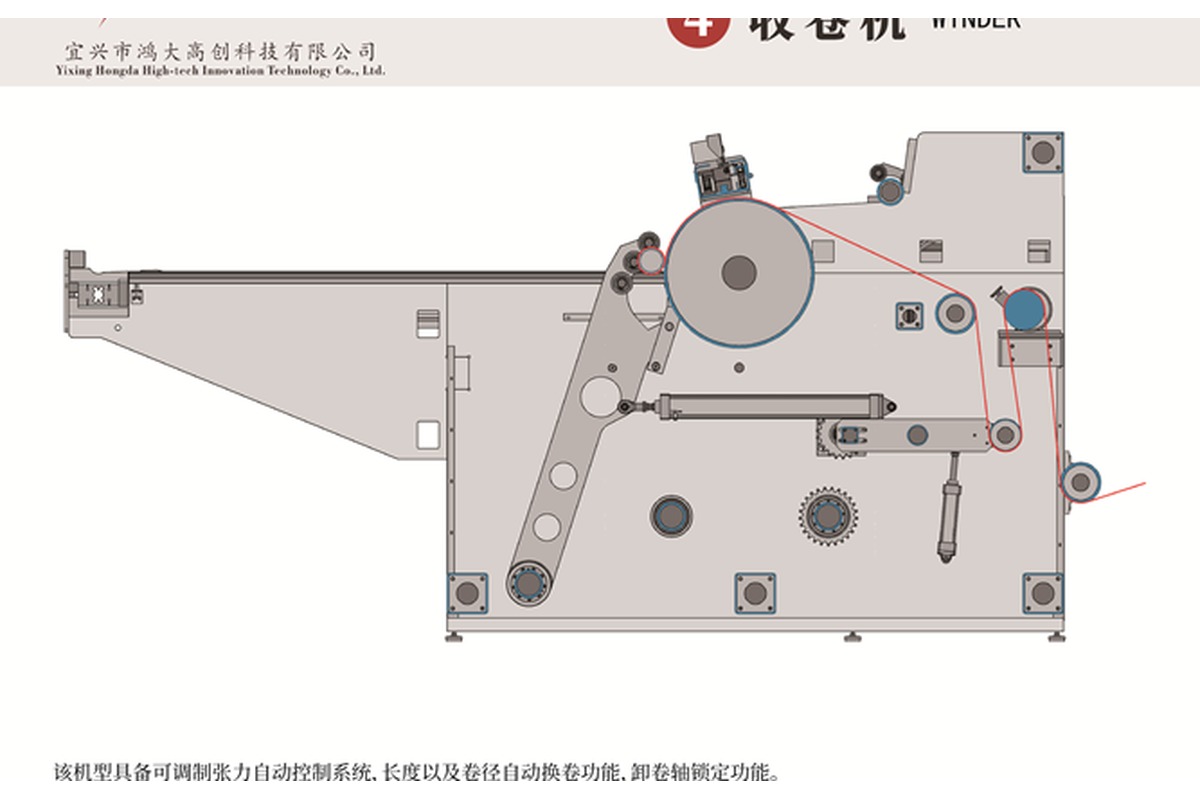
Many machinery inquiries describe the slitting section carefully but leave the rewind-shaft decision vague. That creates a gap in the project, because buyers are not really purchasing knives alone. They are purchasing finished rolls that must be wound tightly enough, straight enough, and consistently enough to survive unloading, storage, transport, and the next converting step. If that final package is unstable, the machine can still look good in a quotation while performing poorly in real production.
The rewind-shaft discussion becomes especially important on center-wound slit rolls. Once several narrow rolls begin building on the same shaft, they do not all behave identically. Some rolls may build faster because the material is slightly thicker in one lane, because the slit widths are different, or because the material itself is more elastic or compressible in one zone than another. That is exactly where buyers should stop thinking only about shaft capacity and start asking whether a differential rewind arrangement is commercially justified.
What a differential rewind shaft actually does
Parkinson Technologies explains the basic principle clearly: on differential rewinding, the individual slit rolls are not positively locked to one common shaft speed. Instead, each roll is allowed to slip relative to the shaft so it can maintain the same effective surface speed as neighboring rolls even when diameters start to diverge. That point matters because the problem is not theoretical. Small differences in material thickness across the web turn into larger roll-diameter differences as more layers build up.
Without differential action, one slit roll can wind too tightly while another winds too loosely. The tighter roll may stretch the material or overload the core. The looser roll may telescope, dish, or become unstable during handling. A differential rewind shaft is one way of reducing that mismatch by letting each roll respond to its own build-up conditions instead of forcing every lane to rotate at exactly the same shaft speed.
Why this is a buyer question, not just a machine-builder question
Suppliers can only recommend the right rewind concept when the buyer describes the real roll-quality requirement. If the RFQ only says "slitter rewinder for nonwoven" or "rewind to 1200 mm," the supplier still has to guess how sensitive the application is to roll hardness variation, telescoping, edge alignment, or core damage. Two machines can look similar in width and speed yet perform very differently when slit rolls start building unevenly.
This is why the decision belongs early in the RFQ. If you wait until detailed design or factory testing, the conversation becomes reactive. By then the buyer is comparing pricing or layout around an assumed rewind method. It is better to raise the question as soon as the finished slit-roll package, material behavior, and downstream process are understood.
What HDPTH can verify locally today
The local HDPTH site already supports a serious rewinding discussion, even where the exact final rewind-shaft option is still project-based. The nonwoven rewinding machines page confirms rewinding widths from 1000 mm to 4500 mm depending on configuration, rewinding diameters from 1200 mm to 2500 mm on the winder range, core requirements from 75 mm to 250 mm, and use across nonwoven, paper, PE film, spunlace, and spunbond. The high-speed slitting machines page confirms that HDPTH configures slitting lines by width, speed, knife system, winding method, and controls rather than forcing one universal structure for every job.
The certificates and patents page also shows relevant rewinding-related patent titles, including Rewinding Shaft for Nonwoven Processing, Parallel Rewinding Device, and Adjustable Pressure Roll Cylinder Control Device for Rewinding Machine. Those references do not prove that every current project should be sold with a differential shaft as standard. They do show that rewinding architecture is a legitimate technical topic in HDPTH's scope and should be discussed openly during supplier evaluation.
When buyers should start asking for differential rewind shafts
The strongest signal is uneven roll build across the shaft. If your current production sees one lane winding hard while another goes soft, or one slit roll telescopes while the next looks acceptable, you already have evidence that a fixed-speed locked-core approach may not be the whole answer. Parkinson specifically notes that materials converted on slitter rewinders often have slight gauge variation across the width, and that those subtle differences require slightly different rotational speeds to maintain equal surface speed and tension.
Catbridge's April 17, 2025 recap on rewind-shaft selection adds a useful commercial filter: no single shaft type is always right, and differential-style shafts become more relevant when the material, slit width, buildup ratio, and application variability make one common shaft speed too blunt an instrument. That is the practical buyer test. If all lanes behave almost identically and the product is forgiving, differential may not be needed. If small variations turn into repeated roll defects, it should be discussed directly.
- Multiple slit rolls on one shaft build to visibly different hardness.
- Gauge or caliper variation across the web is enough to affect roll quality.
- Narrow slit widths or mixed-width patterns increase winding sensitivity.
- The plant is seeing telescoping, starring, dish, or loose outer wraps on some lanes.
- Core crushing, core dust, or difficult roll removal are recurring complaints.
- Downstream converting performance is being affected by inconsistent rewind quality.
When a simpler locked-core approach may still be enough
Not every project needs differential rewind shafts. Some products are broad, stable, and forgiving enough that a locked-core concept is perfectly suitable. Parkinson notes that locked-core rewinding is commonly used when the cores are fixed to the shaft and when the application does not need the rolls to slip relative to one another. Catbridge makes the same point in more recent language: converters often keep more than one shaft style available because the right answer depends on the product, not on fashion.
Buyers should therefore avoid turning differential shafts into a default checkbox. If the finished roll package is simple, the material is consistent, and the plant does not have a history of winding defects, paying for extra shaft sophistication may not create a meaningful return. A good inquiry should ask what problem the option is solving, not just whether the option exists.
| Buyer Condition | Why It Pushes the Project Toward Differential Rewinding |
|---|---|
| Variation in thickness across the parent roll | Different lanes build to different diameters and want different rotational speeds. |
| Many narrow slit rolls on one shaft | Small tension imbalances become more visible in roll edge quality and handling stability. |
| Tension-sensitive materials | Overtight or loose winding creates defects faster than on more forgiving substrates. |
| Mixed-width slit pattern | Different buildup rates can make one common shaft speed less effective. |
| Existing complaints about telescoping or crushed cores | The current rewind arrangement may be forcing lanes to behave the same when they do not. |
Core quality still matters even with the right shaft concept
Buyers sometimes treat the shaft choice as if it solves every winding problem. It does not. Parkinson's core-quality article is a useful reminder that weak, bowed, or dimensionally unstable cores can still cause trouble even when the rewind logic is correct. If the application needs tight winding pressure or heavier finished rolls, a poor core can collapse or deform before the roll leaves the machine.
Universal Converting Equipment adds another practical point from a machinery-builder perspective: their differential-shaft design emphasizes locking the chuck to the core while controlling slip inside the shaft system, which is one reason they highlight reduced core-dust generation. Whether a buyer chooses HDPTH or another supplier, that principle is worth understanding. The question is not only "Do you offer differential shafts?" It is also "Where is the controlled slip occurring, and what does that mean for core wear, roll removal, and narrow-width handling?"
What RFQ data the supplier needs
If you want a useful answer from a supplier, give enough process detail to separate a real rewind-shaft need from a generic request. Start with material type and thickness or GSM. Then add parent-roll width, diameter, and core size. Define the full slit pattern, not just one representative width. If the machine must run several products, explain which one is the most difficult and which one drives the commercial decision.
The supplier also needs the finished roll target: core size, final diameter, and any downstream limitations on roll hardness or edge condition. If the current line produces defects, send photos or videos of telescoping, loose wraps, crushed cores, or lane-to-lane variation. That evidence is more useful than abstract complaints about "bad rewinding" because it helps the supplier judge whether the problem points to differential action, core quality, lay-on behavior, tension control, or something upstream of the rewinder.
- Material family, GSM, caliper, or thickness range
- Parent-roll width, diameter, and core size
- Complete slit-width pattern and narrowest finished width
- Finished roll diameter and target roll package requirements
- Target stable speed, not only headline maximum speed
- Examples of current winding defects by lane if available
- Downstream machine limits or customer quality requirements
- Whether one line must switch frequently between product patterns
Need help deciding whether differential shafts belong in your RFQ?
Send your slit pattern, material data, core size, finished roll target, and photos of any current winding defects. HDPTH can review whether the project should stay simple or move toward a more specialized rewind discussion.
Request RFQ ReviewWhat to verify at factory acceptance
If differential rewind shafts are part of the quoted solution, the buyer should verify more than whether the machine runs. The FAT should show that the slit rolls build consistently enough at realistic speed, that one lane is not going loose while another is over-tight, and that the agreed shaft and chuck arrangement matches the actual product scope. If the machine test uses substitute material, ask what that changes in slip behavior, wound hardness, and core loading relative to the real product.
Roll removal is worth checking too. Universal highlights easier core loading and offloading as part of shaft design. Buyers should confirm that in practice rather than assuming it from a brochure. If finished rolls are difficult to remove, or if narrow widths show core wear or sideways movement during the test, the rewind arrangement may still need clarification. The factory acceptance checklist and the core-size and finished-roll-diameter guide are both relevant because they help buyers define measurable roll-package expectations before shipment.
Commercial rule of thumb for overseas buyers
If your product mix is stable and your slit rolls have no history of tension-related winding defects, start with a simpler rewind discussion and ask the supplier to justify any added complexity. If your line handles variable-gauge material, multiple narrow widths, or repeated lane-to-lane roll-quality complaints, raise the differential-shaft question early and ask what measurable improvement the supplier expects. That is a better approach than treating the option as either always necessary or never necessary.
For overseas projects, the main advantage of asking the question early is not only better machine design. It is better quotation discipline. Once the rewind concept is defined, buyers can compare suppliers on a more equal basis and reduce the chance that hidden rewind assumptions turn into expensive arguments after the machine is already in production.
Buyer FAQs
What is a differential rewind shaft on a slitter rewinder?
It is a rewind-shaft arrangement that lets individual slit rolls slip and build at slightly different rotational speeds so tension can stay more balanced as diameters vary from lane to lane.
When is a differential rewind shaft worth specifying?
It is worth specifying when slit rolls do not build evenly, thickness variation affects lane tension, or the plant is fighting telescoping, loose rolls, core damage, or inconsistent roll hardness.
Does every slitter rewinder need differential rewind shafts?
No. Some products run well with locked-core or other rewind methods. The right choice depends on material behavior, slit pattern, finished roll package, and the level of roll-quality control required.
What buyer data should be sent in the RFQ?
Send material type, GSM or thickness, parent-roll width and diameter, slit widths, target speed, core size, finished roll diameter, downstream limits, and examples of current winding defects.
What should buyers verify during factory testing?
Verify roll hardness consistency, edge alignment, telescoping behavior, core condition after winding, and whether the demonstrated rewind-shaft setup matches the agreed application scope.
Sources
- Parkinson Technologies: Differential vs. Locked-Core Rewinding
- Universal Converting Equipment: Differential Rewind Shafts
- Catbridge: Understanding Cam-Lock Differential Shafts
- Parkinson Technologies: Core Quality - Something So Trivial Can Impact Your Winding Operation
Planning a new slitting or rewinding line?
Share your material range, slit pattern, roll package requirements, and current winding problems. HDPTH can help organize a more practical rewind-configuration discussion before quotation.
Send Your Inquiry