Published August 6, 2026 | By HDPTH Technical Editorial Team
What perforation design means in nonwoven converting
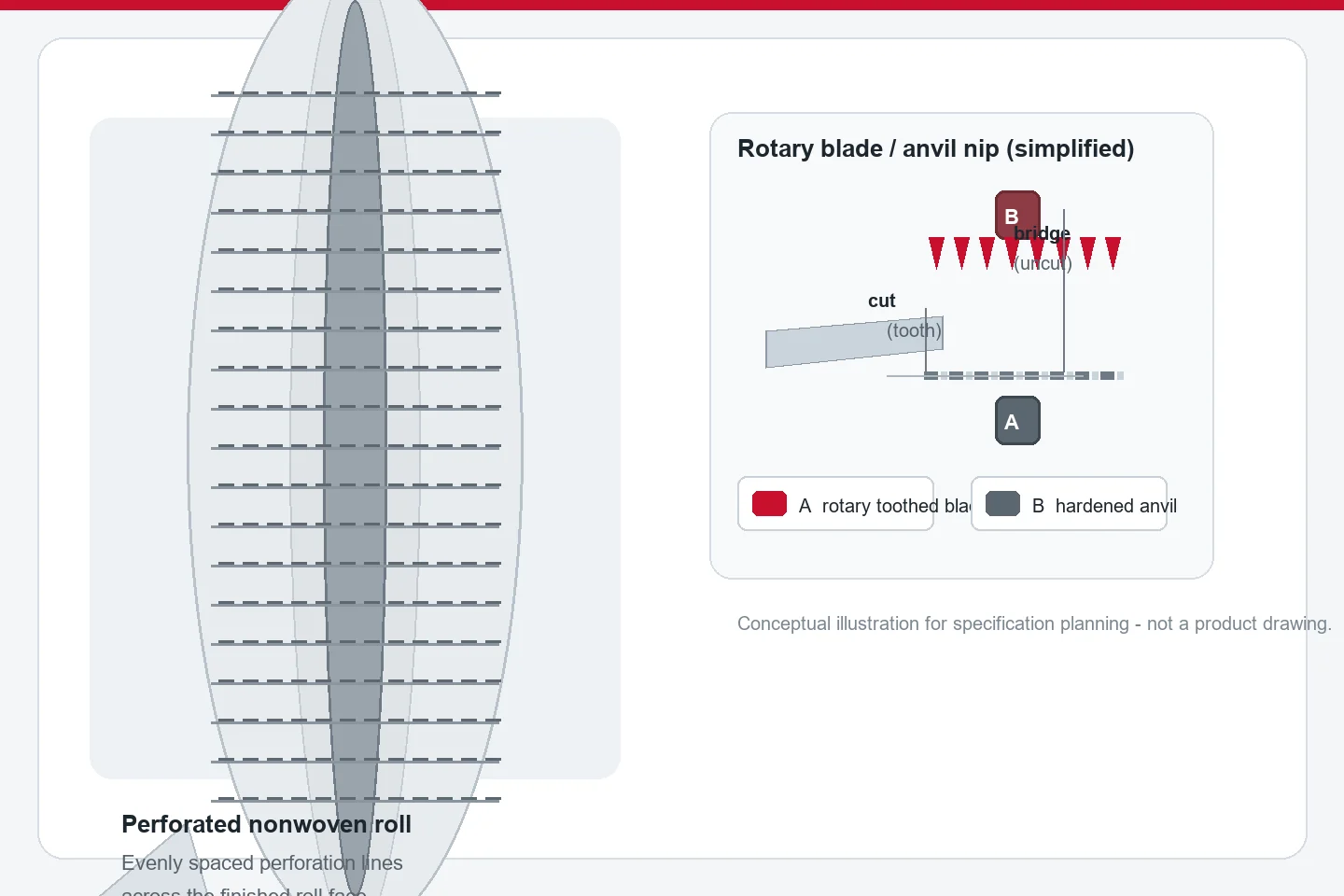
In the industrial converting of nonwoven fabrics — spanning hygiene rolls, wet and dry wipes, medical underpads and industrial cleaning towels — perforation is a precise mechanical process. It creates a controlled series of cuts and intact material "bridges" across the web width, so a continuous roll separates into individual sheets at the point of use.
Perforation design is defined by several interrelated parameters:
- Cut length: the physical length of the slit made through the nonwoven web.
- Bridge length: the uncut, intact portion of the web between two cuts.
- Tooth pitch: the distance from the center of one cut to the center of the next cut along the perforation line.
- Sheet pitch (sheet length): the distance in the machine direction (MD) between one full line of perforations and the next.
- Tear strength: the force required to break the bridges and separate a sheet from the roll.
The primary engineering challenge is achieving the right balance of strength. As noted in U.S. Patent Application US20150298340 on perforating tissue products, converting operations need a delicate equilibrium: perforation lines must be strong enough to withstand the mechanical tension of running reliably on converting equipment without web breaks, yet weak enough for easy, undamaged sheet separation during dispensing. If the perforation is too aggressive, the web snaps inside the rewinder. If it is too conservative, the end user pulls multiple sheets from a dispenser instead of one, or distorts the fabric while tearing it.
Cut-to-bridge ratio and tear strength variables
The foundational metric of any perforation blade specification is the cut-to-bridge ratio: the proportion of cut length (where the blade tooth penetrates the web) to bridge length (the uncut gap that keeps the web intact).
Choosing a starting ratio depends on the final application. According to Finetech Engineering's technical guidelines on perforating blades, a 3:1 ratio (for example, a 3 mm cut paired with a 1 mm bridge) generally yields a perforation that tears easily, while a 1:1 ratio (such as a 2 mm cut and a 2 mm bridge) tears firmly.
Translating these guidelines to nonwoven substrates requires deeper analysis. Nonwovens — whether spunlace, spunbond, hot-air or composite structures — behave differently from paper. Their fiber entanglement gives them distinct stretch and tensile properties. When establishing the correct ratio for a specific product, process engineers must evaluate:
- MD and CD tensile strength: machine-direction (MD) and cross-direction (CD) tensile profiles dictate how much the material stretches before the bridge snaps. Highly elastic nonwovens may need a higher cut-to-bridge ratio for a clean tear.
- Basis weight (GSM): a 15 g/m2 hygiene overlay requires very different perforation tooling than an 80 g/m2 heavy-duty industrial spunlace wipe.
- Wet vs. dry application: as outlined in U.S. Patent CA2962420A1 on wipes dispensing, an optimum wipes perforation pattern must account for both dry converting strength and wet dispensing strength. Adding liquid to a nonwoven roll changes fiber friction and tensile strength, and the drag force of pulling a wipe through a dispenser opening must not exceed the wet perforation's tear strength.
Because of these material interactions, a cut-to-bridge ratio cannot be finalized from theory alone. The final ratio must be validated on the actual production material.
Perforation tooling basics and setup parameters
Industrial nonwoven perforating typically uses a rotary shear or crush-cut configuration, most commonly a rotary toothed blade acting against a hardened anvil (counter blade). Quality perforating blades for wipes converting require precise metallurgical and geometric specification. As detailed by ELSNER Engineering's technical tips on perforator blades, quality blades are made of hardened steel to survive the high-speed friction of continuous converting, and many designs have two cutting edges: when one dulls, the blade can be flipped and the worn side re-sharpened later.
Several mechanical constraints apply when specifying and maintaining this tooling:
- Adjustability and wear: blades typically have slots that allow about 1/8" of mechanical adjustment, and they can generally be sharpened repeatedly until approximately 1/16" of the blade material has been removed.
- Anvil configurations: in systems using a patterned anvil blade, the notches machined into the anvil are typically about 0.063" deep.
- Operational rules: blades should be adjusted in small increments, and operators must never rotate a blade backwards during setup or operation; doing so can damage the cutting edges and change the nip alignment.
- Safety guards: perforating stations present nip and cutting hazards, so equipment design should follow general machine guarding practice such as OSHA 29 CFR 1910.212, which requires guarding of point-of-operation hazards.
Depending on the line layout, perforation can run full-width across the parent roll before slitting or in individual lanes after slitting. Plant managers should also plan spare tooling: running a high-speed line without backup blades and counter-anvils leads to unnecessary downtime when blades are sent out for sharpening.
Need custom perforation tooling for your next nonwoven converting line?
HDPTH configures project-specific perforating, slitting and rewinding systems around your material and application requirements. Share your material details, pitch target and finished roll format for an initial engineering review.
Discuss your project with HDPTHPitch accuracy and sheet-length control
A common source of confusion during specification is conflating the tooth pitch of the blade with the sheet pitch of the final product. The cut-to-bridge ratio determines how easily the sheet tears; the mechanical gearing and servo control of the perforating cylinder determine the actual sheet length (for example, a 250 mm towel).
Maintaining perforation pitch accuracy requires precise synchronization between web speed and the rotational speed of the perforating cylinder. If that synchronization drifts, sheet length varies and rolls are rejected. Modern converting lines use full-servo PLC controls to maintain this electronic gearing so sheet length stays locked in during acceleration and deceleration.
In an RFQ, buyers should state the allowable tolerance for sheet-length variation — for example, ±2 mm over a 300 mm sheet — rather than leaving it implicit.
Tension, web guiding and process speed
A perforating section cannot be specified in isolation. It is one dynamic point in a larger web-handling system, and the tension entering and leaving the perforating nip directly affects both cut quality and pitch accuracy.
If unwinding tension is unstable, the web stretches unevenly and is cut while elongated. When tension relaxes during rewinding, the sheet length contracts, producing short sheets and inconsistent roll build. Similarly, lateral web wandering shifts the perforation line diagonally across the width, harming aesthetics and dispenser compatibility.
Buyers should ask suppliers how tension zones are isolated around the perforator and how the main drive integrates with web guiding. The goal is a flat, evenly tensioned, laterally stable web at the moment the blade penetrates the material.
RFQ data checklist for nonwoven perforation
To receive an accurate technical proposal, buyers should provide comprehensive application data. A robust RFQ for a perforating rewinder includes:
- Material specifications: substrate type (spunlace, hot-air, spunbond, paper, PE film or similar) and basis weight in GSM.
- Tensile data: MD and CD tensile strength data, if available.
- Roll dimensions: parent roll width and diameter, plus target finished roll widths and lane counts.
- Target sheet length: the desired distance between perforation lines and the allowable tolerance.
- Core specifications: parent and finished roll core sizes (for example, 75–250 mm).
- Speed requirements: the steady-state production speed target.
- Application details: end-use dispenser type (center-pull canister, flat pack or similar), tear direction, and whether the product is processed wet or dry downstream.
- Material samples: physical rolls of the exact production material for tooling validation.
Factory acceptance testing (FAT) and acceptance criteria
The true test of a perforation design happens during the factory acceptance test, when the supplier runs the buyer's actual material samples at realistic production speeds. Acceptance criteria should include pitch measurement uniformly across the web width and tear tests. While hand-tearing gives useful subjective feedback, more rigorous testing can align with recognized standards: ISO 12625-12 (tissue paper and tissue products — determination of tensile strength of perforated lines and calculation of perforation efficiency) specifies a tensile test using a constant rate of elongation, measuring the MD tensile strength of cross-direction perforations and calculating perforation efficiency by comparing perforated and non-perforated samples.
For wet wipes, wet-strength checks after perforation confirm that wetted bridges do not fail under normal dispensing strain. The FAT should also verify roll formation quality, acceleration and deceleration behavior without web breaks, and a full inspection of installed tooling and requested spare parts.
Common specification mistakes in converting
Even experienced buyers stumble when specifying perforating systems. The most frequent errors:
- Specifying a hole pattern without tear-strength rules: demanding a "3 mm cut, 1 mm bridge" without stating how much force should be required to tear the sheet.
- Blindly copying competitors: duplicating a competitor's cut-to-bridge ratio without validating it on your material's GSM and fiber blend.
- Ignoring tension dynamics: focusing only on blade geometry while tension fluctuations warp perforation pitch.
- Skipping physical validation: approving equipment from drawings rather than from tear evidence produced at FAT on the exact material.
- Neglecting consumables: forgetting spare blades and anvils, or having no clear internal procedure for sharpening and replacement.
The HDPTH project-based engineering approach
Because perforation variables depend closely on the substrate and final application, HDPTH does not offer a one-size-fits-all catalog model for perforation design. Instead, HDPTH configures perforating lines and combined machines (perforating, slitting and rewinding) on a project basis.
Before engineering blade geometry and machine layout, HDPTH reviews the buyer's material, required width, target speed, pitch and tear requirements. HDPTH nonwoven rewinding machines support production speeds of 40–600 m/min with custom rewinding widths of 1,000–4,500 mm. For projects that combine narrower web division with perforation, the high-speed slitting machine configuration in the product manual covers unwinding diameters up to 2,500 mm and applicable basis weights of 12–120 g/m2. Where frequent width changes matter, HDPTH also supplies automatic knife systems with full-servo PLC control for repeatable row-knife setup and trimming recovery.
For more on deciding when a perforating rewinding machine is needed, see our nonwoven perforating rewinding machine guide. Factory acceptance testing validates roll formation, web alignment and perforation tear behavior on the buyer's material at speed before shipment.
Buyer FAQs
What is the cut-to-bridge ratio in nonwoven perforation?
The cut-to-bridge ratio is the proportional length of the physical cut made by the blade compared to the uncut material (the bridge) left between cuts. For example, a 3:1 ratio means a 3 mm cut followed by a 1 mm bridge, which generally results in a perforation that tears easily.
How is perforation tear strength measured?
While hand-tearing is a common subjective check, precise tear strength is measured using tensile testing equipment. ISO 12625-12 provides a standard method using a constant rate of elongation to determine the machine-direction tensile strength of cross-direction perforated lines.
Why does the same perforation blade behave differently on dry vs. wet wipes?
Adding liquid to a nonwoven substrate alters fiber friction and significantly affects tensile strength. A perforation that holds perfectly during dry converting may become too weak—or conversely, too difficult to tear—once saturated with cleaning solutions, requiring specific cut-to-bridge adjustments.
Can perforation blades be sharpened or adjusted?
Yes, high-quality industrial perforator blades are made of hardened steel and can often be flipped to utilize a second cutting edge. When worn, they can be re-sharpened until roughly 1/16" of the material has been removed, and the mounts usually allow for small adjustments of about 1/8".
Why is my perforation sheet length inconsistent during production?
Inconsistent sheet length (pitch accuracy) is rarely a tooling issue; it is usually caused by unstable web tension, poor web guiding, or electronic synchronization errors between the web speed and the rotational speed of the perforating cylinder during acceleration or deceleration.
Sources
- Finetech Engineering: Perforating Blades — Tear Line and Easy-Open Perforation Knives
- BS EN ISO 12625-12: Determination of Tensile Strength of Perforated Lines and Calculation of Perforation Efficiency
- ELSNER Engineering: Perforator Blade Tips for Converting Machinery
- OSHA: 29 CFR 1910.212 General Requirements for All Machines
Specify perforation that runs and dispenses the way it should
Ready to define cut-to-bridge ratio, pitch and tear-strength acceptance for your wipe, hygiene or industrial roll product? Share your material samples and production data with the HDPTH engineering team for a project-based configuration review.
Send an RFQ to HDPTH