Published July 12, 2026 | By HDPTH Technical Editorial Team
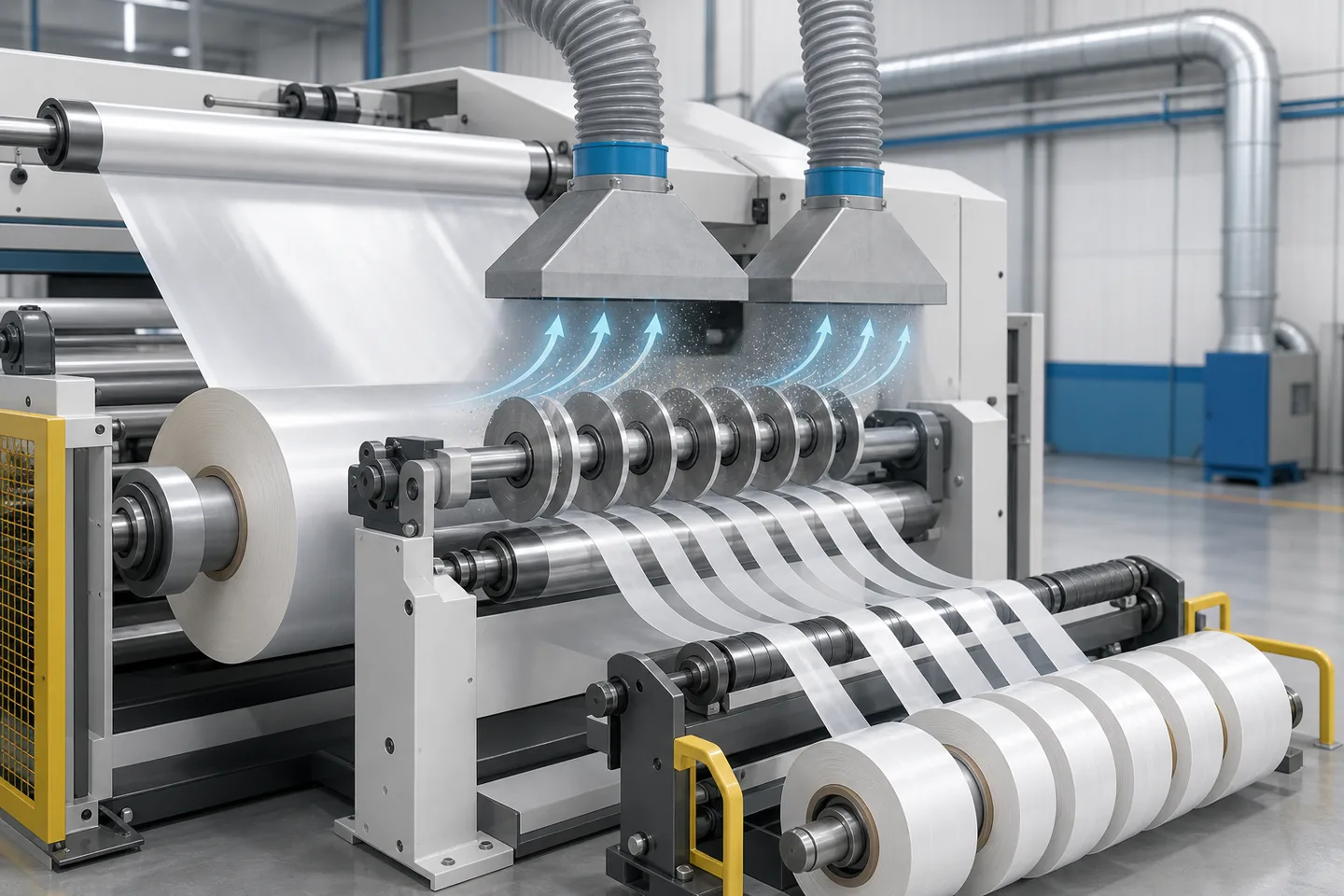
Dust extraction is easy to overlook during machine selection because buyers naturally focus on speed, slit width, knife configuration, tension control and finished-roll diameter. Those items are important, but they do not answer a practical plant question: what happens to fibers and fines after the web is cut?
In high-speed roll converting, the slitting zone can release paper dust, nonwoven fibers, coating debris, film edge particles and loose trim fragments. At low speed this may appear as a housekeeping issue. At higher speed it can travel with boundary layer air, settle on web surfaces, collect around knife holders, interfere with optical sensors, or become trapped between winding layers.
That is why dust extraction should be treated as a project interface, not a last-minute accessory. HDPTH builds custom slitting and rewinding equipment for nonwoven, paper, film, textile and flexible roll materials, and the final configuration is confirmed from customer requirements. If dust control matters to your process, the RFQ should include enough information for the machine-side capture layout to be discussed before drawings are fixed.
Where slitting dust comes from
Mechanical slitting creates particles at the point where the blade, web and backing or counterknife interact. The type of dust depends on the substrate. Paper can release cellulose fines. Spunlace, spunbond and hot-air nonwovens may shed small fibers. PE film and laminated materials may produce edge debris, especially where static charge is high or the knife setup is poor.
The slitting method also matters. Razor, shear and score slitting each create a different particle pattern and access requirement. Shear slitting may need hood clearance around rotating knife holders. Razor slitting may require narrow localized capture near blade blocks. Score slitting can create fines around the contact point and may be sensitive to pressure and backing-roll condition.
HDPTH's public high-speed slitting machine information describes clean cutting, stable tension and accurate rewinding as project goals. The same page notes that width, speed, knife system, winding method and controls are customized by project. Dust extraction belongs in that same discussion because hood placement and duct interfaces can affect operator access, blade changes, web threading and web stability.
When buyers should specify dust extraction
A slitter rewinder dust extraction system is worth evaluating when one or more of these conditions appear in real production:
- Visible dust, lint or fibers accumulate around knives, rollers, sensors or operator stations.
- Finished rolls show embedded particles, specks, surface contamination or inconsistent roll edges.
- Operators stop the line for cleaning more often than expected.
- Static charge holds dust on film, paper or nonwoven webs after slitting.
- Edge trim handling and fine-dust handling interfere with each other.
- The material is paper, tissue, dry nonwoven, textile-like web or another substrate that may create combustible or nuisance dust.
- The plant must satisfy internal safety, hygiene, housekeeping or customer audit requirements.
Do not assume that a faster machine automatically needs a larger dust system, or that a lower-speed line does not need one. The useful question is how much debris your material creates under the planned blade method, speed, humidity, static condition and slit pattern.
RFQ data for machine-side integration
Gemini's draft correctly emphasized that a supplier cannot design meaningful local capture points from a generic request such as "add dust extraction." The RFQ should include the operating data that shapes the mechanical interface.
| RFQ data | Why it matters |
|---|---|
| Material family and samples | Paper, nonwoven, film and textile webs shed different particle types and respond differently to airflow. |
| Basis weight, thickness or film gauge | Light webs can flutter if suction is too close or too strong. |
| Slitting method and active knife count | Determines capture-point quantity, clearance and hood geometry. |
| Minimum slit width and lane pattern | Shows whether hoods must work in narrow, crowded knife layouts. |
| Normal and maximum line speed | Helps facility engineers calculate capture velocity and static pressure for the external system. |
| Static or dust history | Identifies whether static neutralization should be reviewed near the slitting zone. |
| Edge trim plan | Prevents dust extraction and trim recovery airflows from fighting each other. |
| Plant collector concept | Allows the machine supplier to reserve interfaces without taking responsibility for facility design. |
For some HDPTH automatic row-knife slitting configurations, the product manual reference data lists production speed of 500 to 1200 m/min, unwinding diameter of 1200 to 2500 mm, rewinding diameter of 1200 mm, minimum slitting width of 45 to 65 mm and effective winding width of 1500 to 4500 mm. These are reference values for a specific configuration, not universal promises. They show why dust, trim and airflow planning should be tied to the actual material and layout instead of copied from a brochure.
Send dust-control requirements with the RFQ
Share your material, slit pattern, speed target, dust history, trim plan and plant collector concept so HDPTH can review machine-side integration points during configuration discussion.
Submit Your Project InquiryMachine builder and facility specialist responsibilities
Developing an effective dust control strategy requires close coordination between the machinery builder and the buyer's facility engineers. The machinery builder is best positioned to discuss capture points on the slitter, hood clearance, brackets, machine-side ducts, safe blade access, web threading and whether auxiliary equipment needs space near the line.
The facility specialist is responsible for the external system: central dust collector, fan selection, filtration media, duct routing, pressure loss, earthing and bonding, discharge point, noise control, permits and safety protection. If combustible dust is possible, the facility review must include qualified assessment of deflagration and explosion risks.
This boundary is important commercially. A slitter quotation may include local hoods or interfaces, but that does not mean the machine builder has designed the entire plant dust collection system. Buyers should make the scope explicit in the technical agreement, layout drawings and acceptance plan.
Safety and combustible dust review
OSHA states that workplaces generating or handling combustible dust can face fire, flash fire, deflagration or explosion hazards. OSHA hazard communication guidance also lists organic dusts, including paper and certain textile-related dusts, among examples that may present combustible dust concerns when processed in finely divided form.
For North American and European buyers, this is not a topic to solve through machine layout alone. Plant engineers and project managers must independently consult relevant OSHA combustible dust standards, local fire codes, insurance requirements and qualified safety specialists when designing external ductwork and central dust collection systems.
The Canadian Centre for Occupational Health and Safety advises using appropriate dust extraction and collection systems, locating inlets as close as practical to dust-producing processes, following required standards and codes, and locating dust collectors outdoors where possible. These are facility-level engineering decisions. They should inform the slitter project, but they should not be delegated only to the slitter supplier.
Coordinating dust extraction with edge trim recovery
Dust extraction is not the same as edge trim recovery, although the two systems may share space around the slitting section. Edge trim recovery removes continuous waste strips or narrow trim. Dust extraction captures fines, lint and small particles. Some plants keep those streams separate. Others discuss integrated trim and dust extraction with a specialist supplier.
HDPTH has a dedicated article on edge trim recovery on a slitter rewinder, and the product site also shows auxiliary equipment for edge-trim rewinding and line-side material handling. Use those references to define what happens to solid trim. Then define what happens to airborne or fine dust. If both are pulled pneumatically, the airflow around the web path must be reviewed carefully to avoid flutter, unstable trim movement or suction that disturbs narrow slit lanes.
FAT and shipment inspection points
Factory acceptance testing usually cannot prove the full plant dust collector because the buyer's central collector, long duct runs and final filtration are normally installed at the destination facility. FAT can still verify the machine-side readiness.
Mechanical fit and access
Confirm that local hoods, brackets and duct stubs do not block blade changes, knife positioning, roller cleaning, sensor access or manual web threading. If hoods must move for setup, verify the motion, locking method and repeatable return position.
Web path and hood clearance
Run the agreed material sample at representative tension and speed where feasible. Look for flutter, contact marks, edge wandering or air disturbance near the slitting zone. Check that hood adjustment ranges match the slit-width range in the purchase agreement.
Static and electrical interfaces
Static charges can hold fibers and fine dust on web surfaces, making extraction less effective. Positioning static neutralizing bars upstream of the slitting knives can help dissipate surface charges. Proper electrical bonding and earthing of machine-side hoods and ducting interfaces should be reviewed by qualified engineers during installation.
Shipment documentation
Before shipment, confirm which items are packed with the machine: hoods, flexible connections, manifold pieces, brackets, local sensors, cable glands, layout drawings and installation notes. If the external dust collector is outside the machine supplier's scope, the packing list and contract should say so clearly.
Installation and commissioning preparation
Site preparation should start before the machine leaves the factory. The buyer should reserve floor space for duct drops, service access, collector routing, maintenance platforms if needed and safe waste handling. If the collector is outdoors, the path from slitter to collector may require wall penetrations, structural support, weather protection and local permits.
During commissioning, facility engineers can measure airflow at capture points, compare actual pressure loss with design assumptions, check whether suction causes web movement and verify that housekeeping improves without damaging product quality. Where appropriate, they can integrate control interlocks between the central dust collector and the machine PLC so slitting operations are synchronized with auxiliary dust extraction airflow.
Do not accept a system based only on whether the duct is physically connected. Acceptance should include visible dust reduction, stable web handling, safe access, cleaning routine, documented maintenance points and agreement on who services filters, ducts and machine-side hoods.
Buyer checklist before ordering
- Define whether your issue is fine dust, continuous trim, loose fibers, static attraction or a combination.
- Send material samples and operating data with the RFQ, not after layout approval.
- Ask the machine supplier to mark local hood positions, duct interfaces and access clearances on drawings.
- Ask your facility specialist to size the collector, fan, ducting, filtration and safety protection.
- Confirm whether combustible dust testing or a dust hazard analysis is required for your material and jurisdiction.
- Include machine-side dust extraction readiness in the FAT checklist.
- Include airflow, static, housekeeping and product-cleanliness checks in site commissioning.
Plan the machine interface before layout is frozen
HDPTH can review your roll material, slit pattern, target speed, trim handling and dust-control requirements as part of a custom slitting and rewinding project discussion.
Contact HDPTH for Configuration ReviewFrequently asked questions
Why is dust extraction necessary on a slitter rewinder?
Mechanical slitting can generate fibers, fines and airborne particulates. A targeted slitting zone extraction system helps remove debris before it settles on the web, enters finished rolls, affects sensors or accumulates around the operator area.
What data should I send when requesting dust extraction integration?
Send material data, slitting method, minimum slit width, active knife count, normal and maximum speed, parent and finished roll sizes, expected dust or fiber behavior, static issues and whether edge trim extraction must be coordinated with dust capture.
Does HDPTH supply the central dust collector and explosion protection system?
HDPTH can discuss machine-side integration requirements such as local capture points, clearance, mounting interfaces and auxiliary equipment layout. Central collectors, external ducting, filtration, explosion protection, permits and code compliance must be engineered and verified by qualified local facility and safety specialists.
What should be checked during FAT for dust extraction readiness?
FAT should verify mechanical fit, access for blade changes, web threading clearance, hood adjustability, interference with knife positioning, space for duct connections and whether the machine-side interfaces match the agreed layout. Full plant collector performance is normally confirmed after site installation.
How does static electricity affect slitting dust removal?
Static charges can hold fibers and fine dust on nonwoven, paper or film surfaces, making extraction less effective. Static neutralization upstream of the slitting zone can help release particles, but placement and performance should be reviewed according to the actual web path and material behavior.
Sources
- OSHA Directive CPL 03-00-008: Combustible Dust National Emphasis Program
- OSHA: Combustible Dust Standards
- OSHA: Hazard Communication Guidance for Combustible Dusts
- CCOHS: Combustible Dust
- ERS: Trim and Dust Removal for the Paper Converting Industry
- Lundberg Tech: Trim Handling for Slitting and Rewinding