
Published June 13, 2026 | By HDPTH Technical Editorial Team
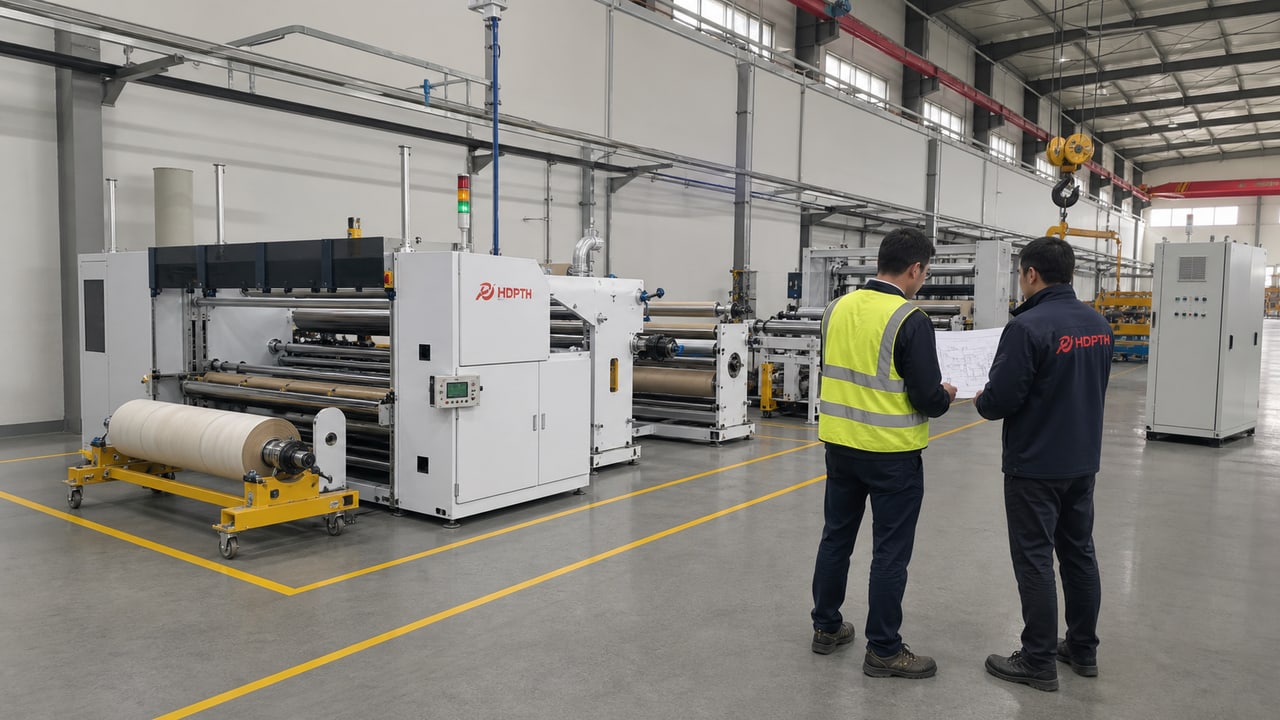
Proper site preparation for an industrial slitter rewinder demands meticulous attention to foundation strength, electrical capacity, and pneumatic utility planning. Ensuring your facility is fully prepared before the machinery arrives from the HDPTH 6,000 m2 manufacturing base prevents costly installation delays and supports stable machine operation during continuous production.
What a buyer should prepare before shipment
Before the slitter rewinder leaves the supplier's workshop, the buyer's engineering team should verify floor load-bearing capacity and overall spatial layout. Slitter rewinders with an effective winding width of 1500 to 4500 mm create meaningful dynamic loads, so the installation zone should be reinforced, level, and clear enough for operators, maintenance personnel, and material-handling equipment.
Because the unwinding diameter can reach 1200 to 2500 mm and the rewinding diameter can reach 1200 mm, the plant should plot forklift or crane movement early rather than improvising after arrival. Utility drops should also be in place before dispatch: these machines require a stable power supply that can support a 35 to 65 kW installed load, plus a clean compressed-air line capable of delivering 0.5 to 1 m3/hour. For projects aiming at a 45 to 65 mm minimum slitting width, stable utilities and vibration control matter even more.
Which machine data changes the site plan
When finalizing your factory layout, technical parameters of the chosen slitter rewinder directly determine the physical footprint and utility planning. A site plan cannot be finalized well without knowing these values, because they affect aisle widths, clearance needs, electrical sizing, and compressor selection.
- The effective winding width, typically 1500 to 4500 mm, helps define the machine footprint and the working clearance needed for loading and unloading rolls.
- Unwinding diameters from 1200 to 2500 mm and rewinding diameters up to 1200 mm influence both vertical and horizontal handling space.
- The 35 to 65 kW installed power requirement determines electrical preparation, including panel capacity and stable industrial distribution.
- The 0.5 to 1 m3/hour air-supply requirement affects compressed-air routing, regulator selection, and line protection near operator traffic.
Utilities, material flow, and safety planning
Industrial slitter rewinders require coordinated utility integration and disciplined safety planning. The site should provide clear access to emergency stops, safe working perimeters, and proper grounding for the machine's electrical system. Pneumatic lines should be routed away from heavy foot traffic and handling lanes to reduce trip hazards and accidental damage. Good lighting and ventilation should also be confirmed before commissioning begins.
Material flow deserves the same attention. The layout should provide unobstructed paths for loading parent rolls and removing finished rolls without forcing awkward forklift turns near the machine. If the project includes recipe-driven setup or automation features, it is also wise to review how staging and operator access may change. Buyers planning automation-related layout decisions can review the current HDPTH scope for automatic knife systems and inspect the broader workshop context on the factory page.
Need help checking your layout before shipment?
If you are still confirming utility capacity, handling clearances, or installation spacing, send the draft layout together with material and roll data before the machine ships.
Request Layout ReviewBuyer checklist before dispatch
| Preparation Category | Verification Requirement |
|---|---|
| Foundation & Layout | Verify floor load-bearing limits and clear the space needed for a 1500 to 4500 mm effective winding width. |
| Electrical Utilities | Install and test the three-phase supply needed for the 35 to 65 kW installed power load with proper grounding. |
| Pneumatic Systems | Route regulated, clean compressed-air lines capable of sustaining 0.5 to 1 m3/hour. |
| Material Handling | Confirm crane or forklift clearance for 1200 to 2500 mm unwinding diameters and 1200 mm rewinding diameters. |
Common site-preparation mistakes buyers should avoid
One common mistake is underestimating the real space needed for safe material flow. Buyers sometimes focus on the machine footprint but do not leave enough room for unloading, staging, and turning movement when handling parent rolls with unwinding diameters between 1200 and 2500 mm. The result is not only awkward handling but also avoidable safety risk once production begins.
Another recurring issue is utility under-preparation. If the factory power system cannot support a stable 35 to 65 kW installed load, or if grounding and compressed-air routing are treated as late-stage details, startup becomes slower and process stability suffers. For projects that expect narrow slit widths in the 45 to 65 mm range, instability in foundation, power, or air supply can quickly undermine process consistency.
What information to send the supplier before dispatch
Before the machine is shipped, the buyer should send the final production and factory data set that will govern layout review, startup preparation, and shipment-readiness checks. Accurate information reduces the risk of last-minute mismatch between the machine configuration and the plant's actual site conditions.
- Material type together with GSM or thickness so the supplier can review process suitability.
- Parent-roll width and diameter, especially when the project will run large unwind rolls within the quoted range.
- Finished slit widths and target speed, including any narrow-width requirement near the minimum slitting range.
- Local electrical standard, including the plant's voltage and frequency assumptions.
- Roll-handling conditions on site, including forklift, crane, or staging limitations near the installation area.
How to organize the installation day and internal coordination
When the equipment arrives, installation day requires disciplined internal coordination rather than last-minute improvisation. Factory managers should brief unloading crews, rigging teams, electricians, and production supervisors on the exact route from receiving area to installation zone. The path should already be cleared for the machine footprint and for safe movement of modules associated with the quoted working width and roll-handling dimensions.
Safety control is the next priority. The installation zone should be cordoned off so that only authorized personnel enter during unloading, positioning, and anchoring. Lockout/tagout planning should already be visible and understood before electrical or pneumatic handoff begins. Emergency-stop access and safe movement corridors should remain clear throughout the installation process rather than being treated as a final housekeeping step.
Once the mechanical structure is positioned, the utility handoff should be handled as a formal checkpoint. Electricians should verify the plant connection prepared for the 35 to 65 kW installed power requirement, while the compressed-air line should be tested for stable delivery in the 0.5 to 1 m3/hour range. These checks support smoother startup and help reduce avoidable troubleshooting during first runs.
- Clear the unloading route and confirm that plant handling equipment can move modules safely to the installation point.
- Set and enforce installation-day safety perimeters before unloading or anchoring begins.
- Verify electrical handoff, grounding, and panel readiness before energizing the line.
- Test compressed-air readiness before the first startup and trial sequence.
What to confirm before final shipment and startup
Before final shipment, buyers should confirm that the installation area is ready not only in principle but in measurable detail. That means checking floor level, confirming marked safety zones, and making sure the route from unloading point to installation position is free of obstacles. Fixed industrial machinery should be anchored securely, and servicing procedures should be supported by lockout/tagout planning before startup begins.
Utility checks also need to be completed before the machine arrives. The electrical connection should be reviewed for phase consistency and grounding, while the compressed-air line should be tested for stable supply. At this stage, the buyer should also reconfirm material type, roll dimensions, target speed, and the final layout drawing so that startup does not stall over missing factory information.
Ready to finalize startup conditions?
Send your material data, width plan, roll diameters, electrical standard, and preliminary layout. HDPTH can review the project before dispatch and help reduce avoidable installation delays.
Discuss Your Site Preparation PlanBuyer FAQs
What are the primary utility requirements for a high-speed slitter rewinder?
A stable industrial power supply is required to handle the 35 to 65 kW installed load, and the site should also provide a clean, regulated compressed-air connection capable of delivering 0.5 to 1 m3/hour for pneumatic functions.
How much space should I allocate around the machine?
Space planning should go beyond the machine footprint. Buyers should reserve room for operator access, maintenance clearance, and safe movement of forklifts or cranes handling parent rolls and finished rolls. Working width, unwinding diameter, and rewinding diameter all affect the real layout.
Why is floor anchoring necessary for slitting machines?
Secure anchoring helps prevent movement and vibration during operation. It also supports long-term alignment stability and protects process accuracy when buyers expect narrow slit widths and repeatable roll quality.
What information is crucial for the supplier before finalizing the layout?
Before layout decisions are frozen, buyers should confirm material type, basis weight or thickness, parent-roll width, finished widths, roll diameters, target speed, and local electrical standard. These items directly affect layout and utility planning.
Can automatic knife systems be discussed as a new-line or upgrade option?
Yes. Verified HDPTH product information shows that automatic knife systems can be discussed either as part of a new line or as an upgrade requirement, depending on the converter's current layout and automation plan.