Published July 6, 2026 | By HDPTH Technical Editorial Team
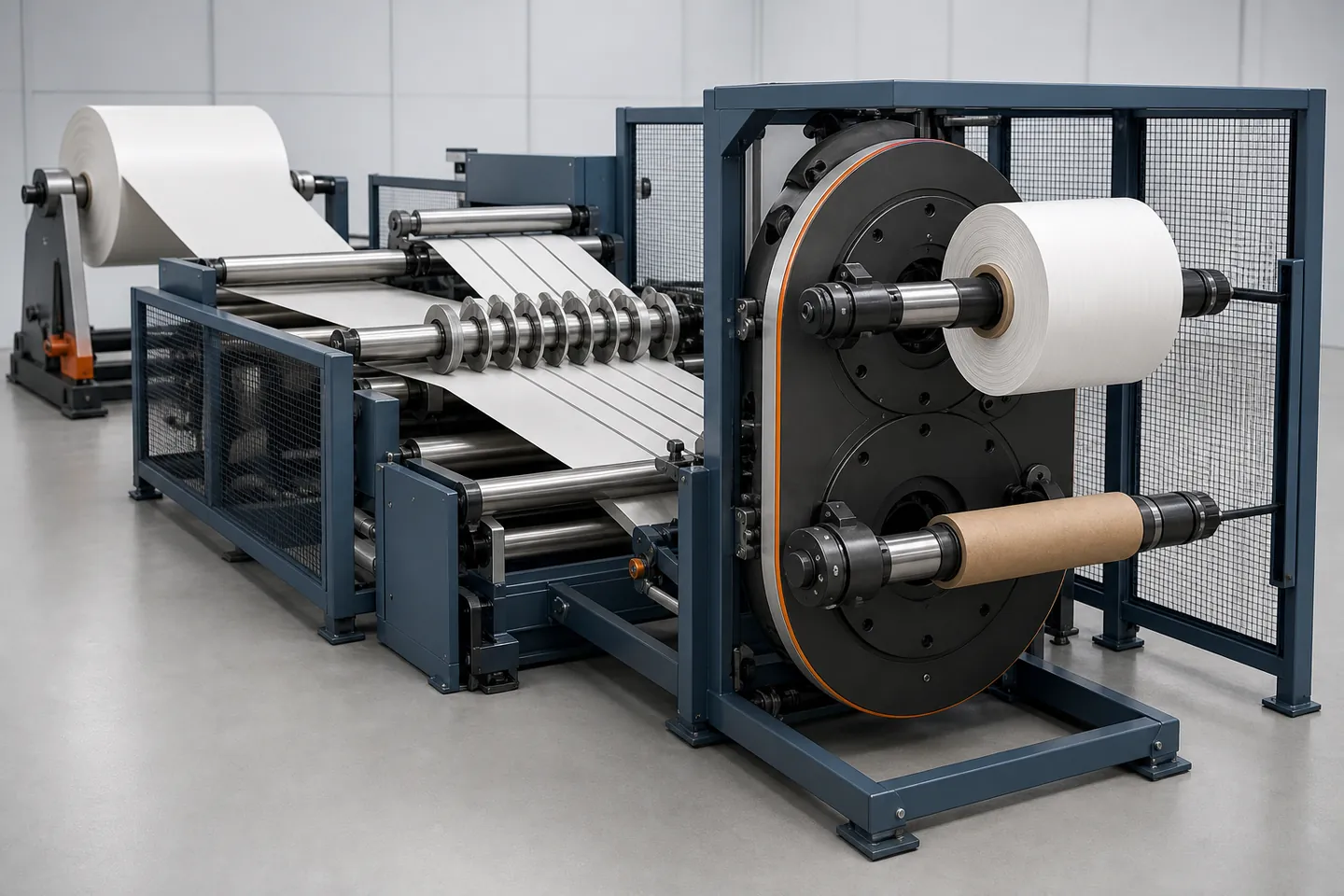
For plant managers and engineers, faster converting speed does not automatically mean higher usable output. If each finished set requires the line to decelerate, stop, cut the web, secure roll tails, unload rolls, fit new cores, reattach the web and accelerate again, changeover time can become the dominant constraint.
A conventional stop-and-change machine performs those tasks in sequence. A turret arrangement is intended to overlap some of them. That can be valuable for short finished rolls and frequent cycles, but the extra mechanics, controls, guarding and maintenance must earn their place in the project.
How a turret rewind arrangement works
A turret slitter rewinder uses a rotating assembly with multiple winding axes. In a typical concept, one shaft or winding position is active while another is available for unloading finished rolls and preparing new cores. When the active set reaches its target length or diameter, the assembly indexes so the prepared position can receive the web.
The amount of automation varies. One machine may only index the turret automatically. Another may add web severing, leading-edge transfer, tail closure, core loading or finished-roll discharge. Market examples from Catbridge and FEBA show that these functions are configurable rather than inherent in every turret machine. A buyer therefore needs a sequence description, not simply the word “automatic” on a quotation.
Turret rewind is not non-stop unwind
The turret addresses the finishing end of the converting line. When the master parent roll is depleted, the line can still need to slow and stop for a splice unless it also has a suitable automatic unwind system. Buyers comparing the two functions should review the separate guide to non-stop unwinding on a slitter rewinder.
Calculate line efficiency from both ends. A fast rewind transfer cannot recover time lost to frequent parent-roll changes, and an automatic unwind cannot prevent downtime caused by slow finished-roll handling.
Relationship to simplex and duplex winding
Turret indexing can be engineered around different winding layouts. A simplex concept generally has one active winding zone at a time. A double-turret or duplex concept can have two active winding zones indexing to separate unloading positions. Read the simplex vs duplex slitter rewinder comparison before assuming that “turret” defines the complete slit-lane and rewind architecture.
Start with measured cycle-time data
Do not justify automation with a generic uptime percentage. Observe representative high-volume recipes and record the production sequence. The useful inputs are:
- Active run time: time spent winding at the normal production speed for one finished set.
- Stopped changeover time: deceleration, cutting, tail handling, unloading, core loading, web attachment and acceleration.
- Changeovers per shift: based on real roll length, rejects, breaks and product mix.
- Changeover scrap: material lost during cutting, threading and restart.
- Labor demand: operator time and any second person required for roll or shaft handling.
A simple baseline is changeover burden = stopped changeover time ÷ (active run time + stopped changeover time). Apply it by recipe and then weight the results by expected production volume. A low active-run-to-changeover ratio signals that frequent finished-roll changes deserve closer study. Long runs that wind for hours may offer too little recoverable time to justify a turret.
Also model the new bottleneck. Faster transfers are not useful if finished rolls cannot leave the unloading zone before the next index, cores arrive late, quality inspection cannot keep pace, or downstream packaging remains constrained.
Define the transfer sequence precisely
The correct transfer mode depends on material stability, roll length, tension window and acceptable scrap. Ask suppliers to classify the proposed sequence clearly.
Stop, index and restart
The line stops at the setpoint, the turret indexes, the cross-cut and attachment steps occur, and the machine restarts. This is not continuous production, but it can make the sequence more repeatable and reduce direct handling at the winding shafts.
Reduced-speed transfer
The line decelerates to an agreed transfer speed, performs the cut and attachment, then accelerates. This can balance changeover time with control of delicate, extensible or tension-sensitive webs. The supplier must state the tested speed and the conditions that require a slower transfer.
Production-speed transfer
A transfer at operating speed places greater demands on cutting, attachment, web control and safety functions. Do not assume it is included because the machine is described as automatic. Require the proposal and FAT criteria to name the material, width, speed, core, roll diameter and transfer success conditions.
Core preparation, web cutting and roll closure
The transfer has three separate quality questions: how the web is cut, how its leading edge attaches to a fresh core, and how the trailing tail is secured on the finished roll. Potential methods include prepared tape, adhesive, electrostatic assistance or a mechanical enveloping sequence. Their suitability depends on substrate behavior, cleanliness rules and downstream use.
Provide core inside diameter, wall thickness, material, width tolerance and surface condition. Define whether cores are manually staged or automatically loaded, how their slit positions are verified and what happens when a core is missing or out of position. For tail closure, state the acceptable tail length, placement, adhesive restrictions and whether the customer expects a sealed roll ready for packing.
Clarify the automation scope before quotation
Send HDPTH your material, parent and finished-roll data, slit pattern, production speed, measured cycle times and required transfer sequence for a project review.
Submit Your Project InquiryTension control and material behavior
Turret rotation changes the web path and the dynamics seen by the rewind. During transfer, the control system may need to manage changing geometry, acceleration and the transition from one winding position to another. Poor coordination can show up as slack, stretching, web breaks, wrinkles or unstable first wraps.
The proposed nonwoven rewinding machine or film-slitting configuration should explain which feedback devices and drives control each tension zone, how transfer ramps are set, and which values are stored in recipes. Lightweight nonwovens, extensible films, paper and laminated webs should not be treated as interchangeable.
Testing with production material is essential. Supplier demonstrations on a stable substitute web cannot prove transfer reliability for a buyer’s low-tension or surface-sensitive substrate.
Operator workflow and roll handling
Automation changes operator work rather than eliminating it. Operators may spend less time cutting and threading, but more time staging cores, checking transfer consumables, monitoring recipes, inspecting rolls and coordinating material flow.
Finished-roll removal must fit the cycle. Depending on roll mass and layout, the project may use manual removal, a roll pusher, receiving trolley, lift table, shaft extraction equipment or a conveyor. The separate guide to slitter rewinder roll unloading systems helps buyers define that interface.
Ask for an operator task chart covering normal running, core preparation, finished-roll discharge, thread-up, jam recovery, sample inspection and planned maintenance. It should show where people stand, when hazardous motion is inhibited and which tasks can occur while another shaft is winding.
Guarding and safe access
A rotating turret, winding shafts, nip points and cutting or transfer mechanisms create hazards that require a machine-specific risk assessment. In the United States, OSHA 29 CFR 1910.212 requires guarding to protect workers from point-of-operation hazards, ingoing nip points and rotating parts. Other destinations and company standards can add requirements.
Do not prescribe one safeguard layout from a sales drawing. Review the risk assessment, operating modes, access points, stopping behavior and validation plan. Possible measures can include fixed guards, interlocked gates or presence-sensing devices, but the chosen architecture must suit the actual machine and its loading and unloading workflow.
FAT should include normal access-control checks and agreed fault tests. Installation acceptance should confirm that final fences, gates, floor interfaces and material-handling equipment match the approved layout.
Maintenance, utilities and delivery preparation
A turret is more mechanically and electrically complex than a conventional stop-and-change rewind. Depending on the design, rotating components may require slip rings, rotary unions, pneumatic manifolds, sensors, cross-cut devices and additional drives. Ask which components are standard, which are project-specific and which have long replacement lead times.
The supplier should provide a preventive-maintenance schedule, lubrication points, sensor setup instructions, fault diagnostics, recommended spares and a clear procedure for safely isolating energy before intervention. Maintenance staff should understand the transfer sequence well enough to diagnose whether a missed transfer came from material, setup, sensor, actuator or control logic.
Before shipment, agree on the packing method, moisture and corrosion protection, lifting points, package dimensions and inventory. Plant engineers need the final layout, equipment loads, floor requirements, electrical supply, compressed-air demand, ventilation needs if any, cable routes and service clearances early enough to prepare the site.
Conventional vs turret rewind: buyer comparison
| Evaluation point | Conventional stop-and-change | Turret slitter rewinder |
|---|---|---|
| Changeover sequence | Machine stops for the full manual sequence | Winding may overlap unloading and core preparation |
| Best starting use case | Longer runs and fewer finished-roll changes | Shorter rolls and frequent, repeatable changes |
| Operator role | Direct cutting, tail handling, threading and unloading | More staging, monitoring, inspection and coordinated handling |
| System complexity | Lower baseline complexity | Additional indexing, transfer, controls and safeguards |
| Floor and handling plan | Standard project clearance | Must include index envelope and unloading or core-preparation zones |
| Acceptance focus | Cut and winding quality plus manual change procedure | Those checks plus repeated transfer and handling reliability |
RFQ checklist for comparable proposals
- Material families, constructions, coatings, thickness or basis-weight range and samples.
- Parent-roll width, diameter, mass, core and incoming roll-quality limits.
- Finished-roll width, diameter, length, mass, core and permitted tail condition.
- Slit pattern, lane count and whether lanes alternate between rewind positions.
- Normal and maximum speed, acceleration profile and required transfer mode.
- Measured active run time, stopped changeover time and changes per shift by recipe.
- Core loading, leading-edge attachment, roll closure and finished-roll discharge scope.
- Recipe, data, alarm, language, plant-integration and remote-support requirements.
- Destination safety requirements, risk-assessment deliverables and operator access needs.
- Installation, training, spares, documentation and acceptance responsibilities.
HDPTH’s public high-speed slitting machine information identifies width, speed, knife system, winding method and controls as project-specific choices. Providing this RFQ data allows those choices to be discussed against the real application rather than a generic machine label.
FAT: prove repeated transfers, not one demonstration
The factory acceptance test should use buyer-approved material, cores and consumables at agreed recipes. Define pass/fail values before the test, then run consecutive transfers under the relevant modes. One successful roll change is not evidence of a stable production sequence.
Record the commanded and actual transfer speed, cut and attachment result, first-wrap condition, tension behavior, roll alignment, finished-roll tail, scrap length, alarms and operator interventions. Include low and high operating conditions where they affect the contract. Test missing-core or failed-transfer detection only through an agreed safe procedure.
Use the existing slitter rewinder FAT checklist as a baseline, then add turret-specific criteria: number of consecutive cycles, allowed missed transfers, core-position tolerance, discharge completion, index repeatability, changeover time and recovery after a controlled stop. Keep the signed data and approved recipe with the shipment record.
Define the project with measurable data
HDPTH manufactures slitting and rewinding equipment for nonwoven, paper, film, textile and flexible roll applications. Share your widths, speeds, roll sizes, slit pattern, cycle data and automation goals for a configuration review.
Contact HDPTH for Project ReviewFrequently asked questions
Does a turret slitter rewinder eliminate all line stoppages?
No. A turret slitter rewinder addresses finished-roll changeovers at the rewind. The line may still need to decelerate and stop when the parent roll is depleted unless the unwind also has an appropriate automatic splicing system.
Can any roll material be processed on a turret rewinder?
Transfer reliability depends on material behavior. Stable paper, nonwovens and films may suit an automatic transfer, while highly extensible, delicate or tension-sensitive webs can require a different transfer method or speed. The supplier should test the buyer’s actual material.
Are all turret roll changes performed at full production speed?
No. Depending on the design and material, a turret may transfer at production speed, at a reduced speed, or after a controlled stop. The quotation and FAT plan should state the transfer mode and the conditions under which it must work.
What safety requirements apply to a turret slitter rewinder?
The machine needs a project-specific risk assessment and safeguards appropriate to its rotating parts, nip points, cutting and transfer areas, loading zones and maintenance access. In the United States, OSHA 29 CFR 1910.212 requires guarding against point-of-operation, ingoing-nip-point and rotating-part hazards.
Can an existing conventional slitter rewinder be upgraded to a turret?
Retrofit feasibility is highly case-specific. Turret geometry, drives, controls, handling equipment and safeguarding can require a major redesign, so buyers should compare a retrofit study with the cost and risk of a purpose-built machine.