Published June 24, 2026 | By HDPTH Technical Editorial Team
A buyer may write "finished roll width 150 mm" in a quotation request and assume the meaning is obvious. For a machine builder, that single number is incomplete. Is the 150 mm roll one lane among many different widths? Is trim included? Does the material stretch, curl, fuzz or wander under tension? Will the roll be measured at the roll face, after unwinding, or after storage?
These details decide whether a slitter rewinder proposal is technically comparable. Width accuracy is affected by the knife system, web guiding, tension stability, material behavior, trim removal, operator setup and finished roll handling. A low price quotation that only repeats maximum web width and speed may miss the real acceptance requirement.
This guide is written for overseas factory owners, plant managers, engineers and procurement teams who need a practical way to specify slit width tolerance before ordering a nonwoven, paper, film or flexible-material slitter rewinder.
Slit width tolerance versus minimum slit width
Slit width tolerance is the allowed variation between the target finished roll width and the measured finished roll width. It should be written with the measurement method and acceptance point.
Minimum slit width is different. It is the narrowest lane the machine can practically slit and rewind under the agreed material, knife, shaft, core, tension and finished roll conditions. A machine may be able to create a narrow strip, but that does not automatically mean it can rewind the strip into a stable customer-ready roll at the target speed and diameter.
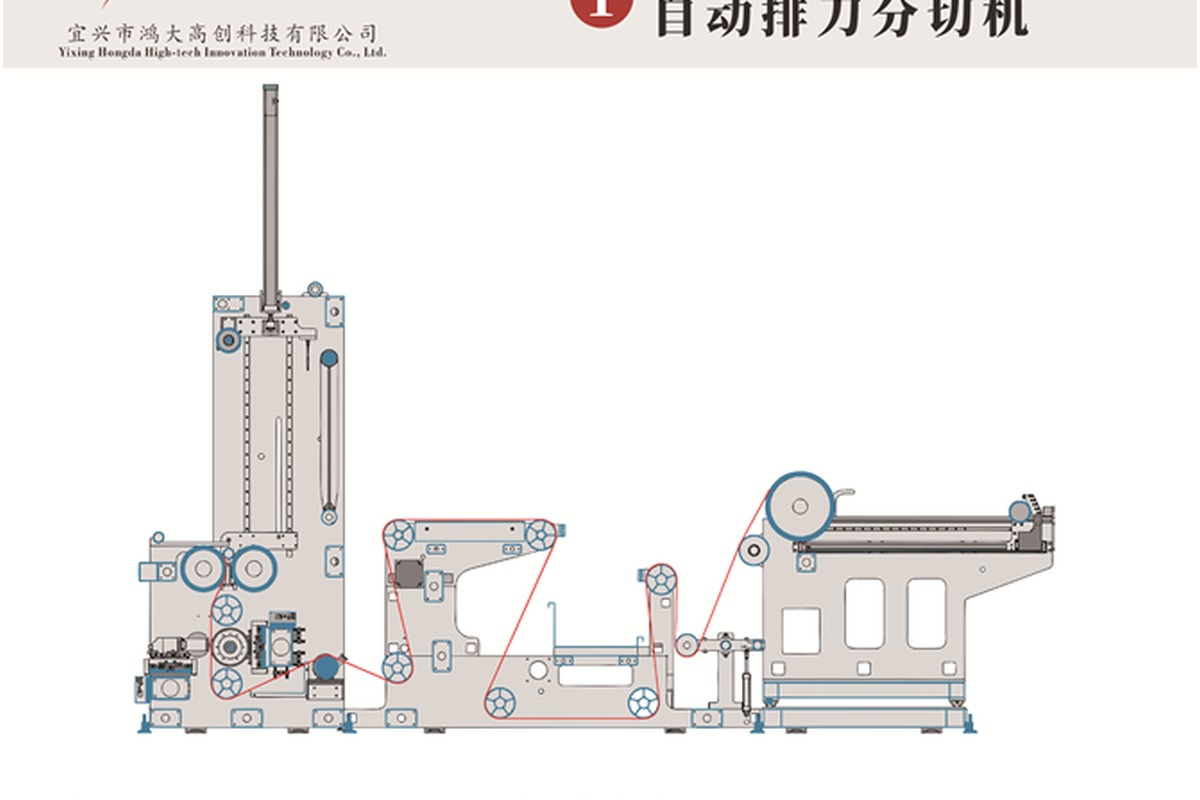
HDPTH's high-speed slitting machines page lists manual-based reference data for an automatic row knife slitting machine, including a 45-65 mm minimum slitting width range, 1500-4500 mm effective winding width, 500-1200 m/min production speed, and applicable materials including nonwoven fabric, PE film, paper, hot air, spunlace and spunbond. Those figures are useful starting points, but final acceptance must be tied to the buyer's real material and roll package.
Why width tolerance is a purchasing issue, not only a QA issue
In many factories, width tolerance is treated as a quality-control topic after the machine is installed. That is late. Width requirement should influence the purchase specification because it changes the machine configuration discussion.
A hygiene converting plant may need stable lane width so rolls feed accurately into downstream packaging or folding equipment. A flexible packaging converter may need clean edges and repeatable width before printing, laminating or bag making. A nonwoven wipes producer may need consistent roll width so perforating, rewinding and packing remain aligned. If the finished roll is outside tolerance, the plant may face rejects, extra trimming, downstream stoppages or customer complaints.
Speed, web width and automation are important, but they are not enough. The buyer should ask what finished width tolerance can be demonstrated with the real material, slit pattern, roll diameter and speed target.
The RFQ data suppliers need
A width-tolerance discussion becomes much more useful when the buyer sends a complete width layout. The supplier should not have to infer the lane arrangement from one finished width.
| RFQ Item | Why It Matters | Buyer Example |
|---|---|---|
| Parent roll width | Sets the available web width and trim calculation | 1600 mm parent roll |
| Finished widths | Defines each slit lane, not just one nominal width | 8 lanes x 180 mm plus edge trim |
| Tolerance target | Turns width into an acceptance criterion | Confirm by agreed measurement method |
| Trim allowance | Prevents unrealistic layouts that consume the full parent width | State left and right edge trim |
| Material and GSM/thickness | Material stretch, compression and edge behavior affect cutting | Spunlace nonwoven, PE film, paper or laminate |
| Core ID and roll diameter | Narrow rolls must still rewind and unload reliably | 76 mm core, target OD 800 mm |
| Edge quality requirement | Width accuracy is not enough if edges are dusty or ragged | Clean edge for downstream converting |
| Changeover frequency | Frequent patterns may justify automatic knife positioning | Daily width recipe changes |
Material behavior changes the tolerance conversation
The same nominal width requirement is not equally difficult across materials. A stiff paper web, a soft nonwoven, a stretchy PE film and a thin PET film create different challenges. Some materials track well through the web path. Others stretch, neck in, wrinkle, curl, shed fibers, or react strongly to tension changes.
This is why general tolerance claims can be misleading when they are detached from the application. The buyer should send representative samples or at least clear material specifications, then ask which material is the limiting case for width accuracy.
Parkinson Technologies' slitting guidance explains that razor, shear and score methods are selected according to material type and thickness. That principle applies directly to width tolerance. The knife method and holder setup influence not only edge appearance, but also how repeatably the lane is formed.
Knife setup and automatic positioning
Knife positioning is the most visible part of slit width control. Manual setup can be acceptable when patterns change rarely and operators are skilled, but every manual adjustment creates opportunity for measurement, locking or documentation variation. Automatic knife positioning can reduce setup time and support repeatable recipes when a factory changes widths often.
HDPTH's automatic knife systems page describes automatic knife solutions for nonwoven slitting and rewinding applications, with manual-based data for automatic row knife slitting capability and full-servo PLC control. For buyers, the practical question is not whether automation sounds modern. It is whether the number of width changes, lane count, tolerance expectation and labor conditions justify specifying it.
Even with automatic positioning, width tolerance still depends on the whole process. Blades must be suitable for the material. Knife holders must be maintained. Web guiding must present the web consistently. Tension must not distort the material before or through the cutting zone. Operators still need a measurement routine and a documented acceptance record.
Web guiding, tension and trim allowance
A perfect knife layout cannot compensate for a web that wanders before the slitting zone. Web guiding helps keep the material aligned, but the guide must be correctly located, tuned and maintained. If the parent roll edge is poor, the web guide may constantly correct, and the lane position may still vary. For edge-guided operation, edge quality matters. For center-guided operation, parent roll centering and web path stability matter.
Tension also affects width. Stretch-sensitive materials can change dimension under load. Uneven tension can create wrinkles, lane instability or roll-build problems that show up as apparent width variation. PFFC's web slitting coverage emphasizes practical objectives such as clean slit edges, correct width and low dust. Those objectives are linked; a narrow roll that meets width but produces dust or edge damage is not a successful result.
Trim allowance is another common RFQ gap. If the layout uses the entire parent roll width with no realistic trim, the supplier has less room to remove damaged or uneven edges. Converting Quarterly notes that trim slitting can be used to establish a clean roll face and accurate full-roll width before precision slit rolls are produced. Buyers should define expected trim instead of treating trim as wasted space with no process value.
How to compare supplier quotations
Two supplier proposals may both say "high precision slitting." A better comparison asks what each supplier is willing to define, test and document.
- Does the quotation show the finished width layout and trim allowance?
- Does it identify the knife method and whether the knife system is manual or automatic?
- Does it state whether minimum slit width is based on the buyer's material and roll diameter?
- Does it explain how web guiding and tension control support width repeatability?
- Does it include a FAT method for measuring finished roll width and edge quality?
- Does it ask for core size, finished roll diameter and downstream use?
- Does it separate machine capability from accepted production speed?
Missing details usually reappear later as change orders, unstable operation, slower production speed or disputes during acceptance testing.
Need a width-layout review before quotation?
Send HDPTH your parent roll width, finished width layout, trim allowance, material, core ID, finished roll diameter, speed target and edge quality requirement. The response can focus on the machine configuration that supports your real tolerance target.
Request Slitting Configuration ReviewFAT checks for slit width tolerance
Factory acceptance testing should turn the RFQ requirement into visible evidence. A useful FAT does not simply run the machine for a short video. It checks whether the agreed material or substitute can be slit and rewound into finished rolls that meet the width layout, edge quality and roll-build expectations.
For slit width, the buyer and supplier should agree on the measuring tool, sampling points and timing. Measure after the machine reaches stable running, not only during setup. Check multiple lanes, especially edge lanes and narrow lanes. If the pattern includes different widths, measure every width category. Record speed, tension setting, knife recipe, trim condition and any operator adjustment made during the test.
Keep measured results with the FAT record. If acceptable width is demonstrated only at a slower speed than quoted, document that difference before shipment. If FAT uses substitute material, identify the remaining commissioning risk.
Common mistakes in width-tolerance RFQs
The first mistake is asking only for "minimum slit width." That number is useful, but it does not describe roll stability, tolerance, speed or edge quality. A very narrow lane can be difficult to rewind depending on core size, differential winding needs, material stiffness and finished diameter.
The second mistake is assuming that maximum machine speed applies to every slit pattern. Narrow lanes, sensitive materials and strict edge quality may require a different stable production speed. HDPTH's manual-based reference speed for the automatic row knife slitting machine is a machine configuration reference; the accepted speed should still be discussed against the buyer's material and finished roll requirement.
The third mistake is omitting downstream process needs. A roll for intermediate storage may have a different width and edge requirement from a roll that feeds directly into high-speed converting, packaging, printing or laminating. Tell the supplier where the roll goes next.
The fourth mistake is treating cores as unrelated to width. For narrow rolls, core quality, core length, shaft fit and unloading method can affect the roll face and perceived width quality. This connects slit width with finished roll diameter and core specification, which HDPTH covers separately in the core size and finished roll diameter guide.
When automatic knife positioning is worth considering
Automatic knife positioning is most relevant when the plant changes width patterns often, uses many lanes, has strict recipe repeatability needs, or wants to reduce manual setup time. It can also help when plants need better documentation of width recipes across shifts.
It may be less urgent when the plant runs one or two stable patterns for long campaigns. In that case, the buyer may gain more from better tension control, web guiding, shaft selection, roll handling or operator procedure.
For broader context, HDPTH has a dedicated article on automatic knife positioning systems for slitter rewinders. Use that article after defining the actual width patterns and changeover frequency.
Practical buyer checklist
Before sending an inquiry, prepare a simple width-layout sheet. It does not need to be complex, but it should remove ambiguity.
- Parent roll width, maximum parent roll OD and parent core ID
- Finished width for each lane and quantity of lanes
- Left and right trim allowance
- Target slit width tolerance and measurement method
- Material type, GSM or thickness, and any coating or surface sensitivity
- Finished roll OD, core ID, core material and downstream use
- Required edge condition: no fuzz, low dust, clean edge, or standard industrial cut
- Changeover frequency and whether recipes repeat
- Target stable speed, not only desired maximum speed
- FAT material availability and acceptance criteria
Buyer FAQs
What is slit width tolerance on a slitter rewinder?
Slit width tolerance is the allowed variation between the target finished roll width and the measured roll width after slitting and rewinding. Buyers should define it as a measurable plus/minus value and state where and how the roll will be measured.
Is minimum slit width the same as slit width tolerance?
No. Minimum slit width is the narrowest lane the machine can practically slit and rewind under the agreed material and roll conditions. Slit width tolerance is the allowed width variation around a target width.
What information should buyers send before asking for width tolerance?
Send material type, GSM or thickness, parent roll width, finished widths, number of lanes, trim allowance, core ID, finished roll diameter, edge quality expectation, speed target and downstream process.
Can automatic knife positioning improve slit width repeatability?
Automatic knife positioning can reduce manual setup variation and support repeatable width recipes, especially when a plant changes slit patterns often. The final result still depends on material behavior, knife method, web guiding, tension control, blade condition and operator verification.
How should slit width be checked during factory acceptance testing?
During FAT, check every agreed lane after startup and stable running, record the measurement method, confirm edge quality, verify trim allowance, inspect roll face condition and keep the accepted knife recipe or setup record with the test report.
Sources
- Paper, Film & Foil Converter: Web Slitting, The Big Three
- Converting Quarterly: Basic parameters to match best slitter to the application
- Converting Quarterly: The basics of web trim slitting
- Parkinson Technologies: Slitting Techniques, A Basic Guide
Ready to specify slit width tolerance for a new line?
Share your width layout, material, trim allowance, core and finished roll details with HDPTH. A clear technical inquiry helps the quotation focus on the slitting, winding and automation choices that matter.
Send Your Slitting RFQ