Published July 12, 2026 | By HDPTH Technical Editorial Team
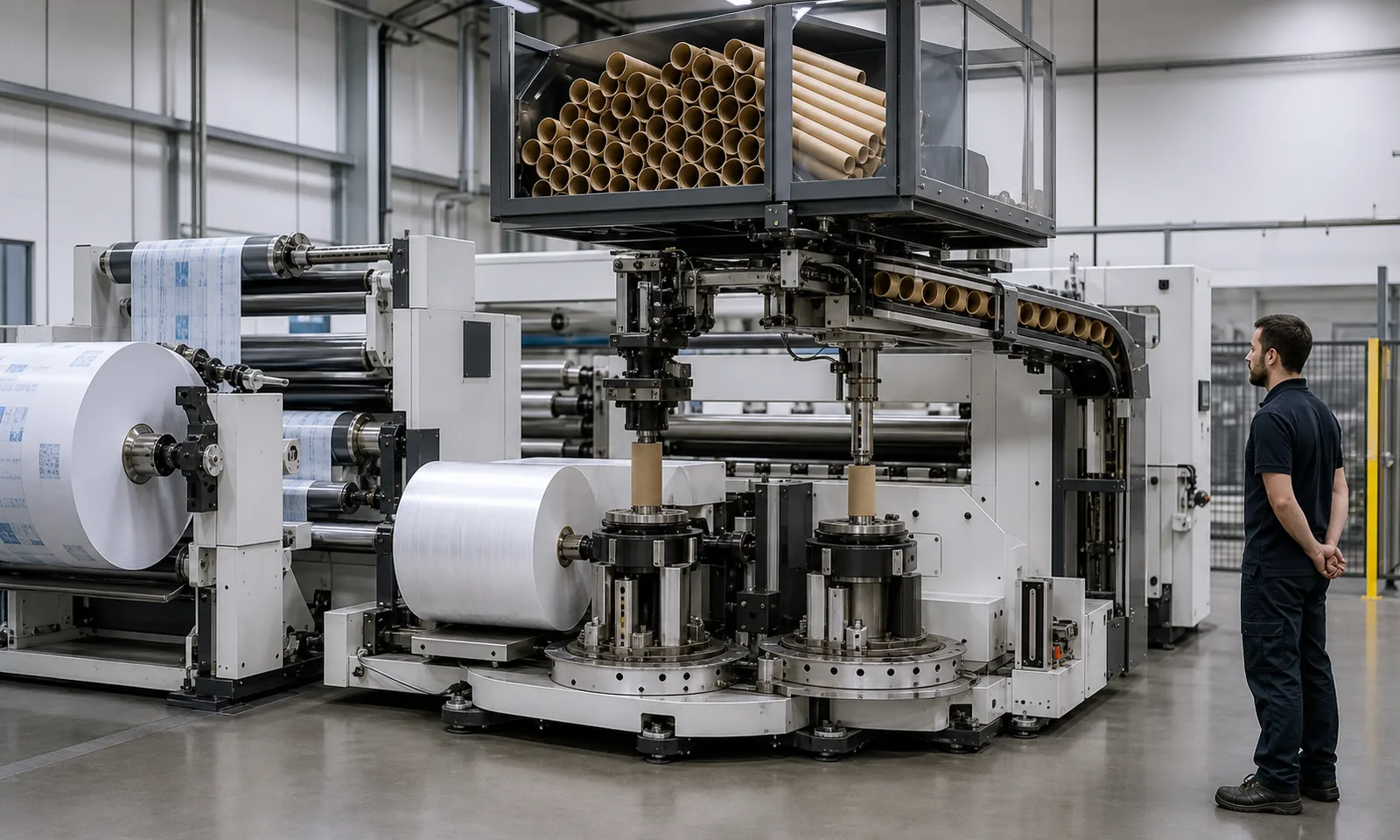
On a conventional turret slitter rewinder, the line still depends on people to load empty cores, set them in position, and prepare the next rewind shaft for transfer. That is workable when the run is long and changeovers are rare. It becomes much less comfortable when the factory is producing many short rolls, narrow slit widths, or product families that cycle through the machine quickly.
Automatic core loading changes that balance. Instead of asking the operator to place every core during the stopped window, the machine uses a hopper, magazine, or other feed arrangement to stage and transfer cores ahead of the next cycle. The purpose is not to add automation for its own sake. The purpose is to reduce repetitive handling and create a more repeatable sequence for every finished set.
What automatic core loading actually changes
In a hand-loaded sequence, the operator is doing several jobs at once: clearing finished rolls, placing new cores, checking spacing, applying adhesive or tape if required, and making sure the next web transfer will start cleanly. Each of those tasks needs time and attention during the same changeover window. If the line is making many short products, the changeover work can begin to dominate the shift.
With automatic core loading, the machine stages the cores while the active shaft is still winding. When the turret indexes, the next shaft already has the correct cores in place or nearly in place, which narrows the manual part of the cycle to supervision, verification, and recovery if something does not match the recipe. That is why buyers should think about core loading as part of the full changeover system, not as a standalone accessory.
Manual and automatic workflow, side by side
| Step | Manual core loading | Automatic core loading |
|---|---|---|
| Core staging | Operator brings cores to the rewind station one by one | Cores wait in a hopper or magazine for controlled feed |
| Core placement | Operator slides and spaces each core by hand | The loader positions cores to the programmed slit pattern |
| Adhesive or tape | Applied by hand during the stopped window | Can be staged or applied as part of the sequence, if included |
| Cutover | Depends on operator speed and consistency | Depends on sensor confirmation and transfer timing |
| Recovery | Usually handled directly by the operator | Must be defined in the control logic and FAT plan |
When it is worth specifying
Automatic core loading usually makes sense when the project has one or more of these characteristics: short runs, frequent roll changes, many narrow lanes per shaft, or a plant layout that makes repeated manual core handling awkward. It can also be attractive when the factory wants to reduce operator exposure near the rewind zone or simplify the work of a single operator supervising several lines.
The more frequently the line changes over, the more important the core-loading step becomes. A short changeover on paper can still be a major issue in practice if it repeats many times in a shift. That is why buyers should not decide from machine catalog language alone. They should compare the proposed loader to the actual roll recipes, the finished-roll handling method, and the amount of operator intervention the plant is willing to accept.
This is the same logic used when buyers evaluate a turret slitter rewinder buyer's guide: look at the whole change sequence, not just the headline machine type. If the finished rolls also need a controlled discharge path, review the roll unloading system guide at the same time so the loader and the discharge side are synchronized.
What the loader needs to match
A core-loading system is only as good as the information it receives. The supplier needs to know the core material, inside diameter, wall thickness, length, and the number of cores on each shaft. The buyer also needs to explain whether the project uses paperboard or plastic cores, whether the core quality is tightly controlled, and whether the machine will run dedicated recipes or a wider mix of slit patterns.
The other key fit point is the rewind shaft and the rest of the turret geometry. If the line uses a shaft layout that does not easily support staging or transfer, the loader may need more space, different tooling, or a different transfer sequence. For that reason, the buyer should not treat automatic core loading as a bolt-on feature. It is a project-specific engineering decision tied to the rewind architecture and the finished-roll handling plan.
Buyers should watch for these failure points
- Core dimensions vary enough to cause jams, drift, or poor shaft engagement.
- The adhesive method is not matched to the web and core surface.
- The loader is not synchronized with the roll discharge or turret index.
- Operator access is still required in the danger zone during transfer.
- Recovery after a fault is not described clearly in the control logic.
Those risks are not reasons to avoid automation. They are reasons to specify it carefully. A well-scoped loader can be a useful productivity tool. A poorly scoped loader can become another point of failure.
Why core quality matters more on an automated line
When a person loads cores by hand, there is room for correction. A slightly tight core can be nudged into place. A poor cut can be rejected. A minor spacing issue can be adjusted before the next cycle starts. Automation removes much of that flexibility, which is why the core specification becomes more important, not less.
If the core is undersized, warped, or badly cut, the loader may misfeed or fail to seat it properly. If the core length is inconsistent, the slit lanes may not land where the buyer expects them to land. If the core surface does not cooperate with the adhesive or transfer method, the core may not hold during web attachment. In other words, the loader does not hide bad input quality; it exposes it faster.
What to put in the RFQ
For a good quotation, the supplier needs more than a target speed and a machine width. Buyers should send the material family, slit pattern, core type, core inside diameter, wall thickness, core length, typical and maximum roll dimensions, and the finished-roll unloading method. If the line must interact with a wrapper, conveyor, trolley, or downstream packaging station, that should be stated in the first request rather than added later.
It also helps to include the production pattern. A line that runs one dedicated width all week can be configured differently from a line that changes widths throughout the shift. If the buyer has a known cycle problem, the RFQ should say so plainly. A supplier can work with a real bottleneck. It cannot work well with a vague request for “more automation.”
Need the loader and the rewind sequence defined together?
Send your core dimensions, slit pattern, roll recipe, finished-roll handling method and expected changeover frequency through the inquiry page. HDPTH can review the full machine concept with you before quotation.
Start Your RFQWhat FAT should prove
Factory acceptance testing should not stop at a single successful transfer. Ask the supplier to show repeated cycles with the buyer's actual core type and representative material. The test should confirm that the loader stages the correct cores, that the cores seat properly on the shaft, that the turret indexes cleanly, and that the unload side does not interfere with the next load sequence.
The FAT should also check the fault path. What happens if a core is absent? What happens if the transfer is incomplete? What happens if the guard is open or the operator interrupts the sequence? The answer should not be hidden in maintenance notes. It should be visible in the control logic, the safety design, and the operator procedure.
For buyers who want a broader acceptance framework, this guide pairs well with HDPTH's core size and finished roll diameter guide and the general FAT checklist. Those pages help define the mechanical limits and the test method around the loader.
How this fits HDPTH's public site
HDPTH's public product pages show that the company builds project-specific converting equipment rather than a one-size-fits-all machine. The high-speed slitting machines page identifies width, speed, knife system, winding method and controls as configurable choices. The slitting and rewinding lines page shows that line layout, number of unwind stations and roll-handling arrangement are all project-based decisions.
That is exactly how automatic core loading should be discussed. It belongs in the same project conversation as the slit pattern, rewind layout, finished-roll discharge, site utilities and destination safety requirements. Buyers who want to review certificates and company documentation before moving ahead can also start from the certificates page.
Buyer FAQs
What does automatic core loading actually do on a turret slitter rewinder?
It stages empty cores in a hopper or magazine, aligns them to the slit pattern, and transfers them onto the idle rewind shaft so the operator does not have to place every core by hand during each changeover.
When is automatic core loading worth specifying?
It is usually worth discussing when the line makes many short runs, the rewind uses many narrow cores, the plant wants less manual handling, or the project needs cleaner and more repeatable changeovers than a hand-loaded sequence can provide.
What RFQ data matters most for a core loader?
Buyers should provide core material, inside diameter, wall thickness, length, slit pattern, number of cores per shaft, run length, finished-roll handling method, utility limits and the destination safety requirements so the supplier can size the loader and its transfer sequence correctly.
What can go wrong if the core tolerances are poor?
If a core is out of tolerance, the loader may jam, miss position, misalign the slit lanes, or fail to transfer the core cleanly onto the shaft. That is why automated systems need tighter core quality control than a manual line.
How should buyers verify the system during FAT?
Ask the supplier to demonstrate representative cycles with the buyer's actual cores and material, then confirm transfer timing, alignment, guarding, fault recovery and interaction with finished-roll unloading before the machine ships.
Sources
- Catbridge: Automatic Core Loading System for Turret Slitter Rewinders
- Catbridge: Turret Slitter Rewinders
- FEBA: Turret Slitters-Rewinders
- OSHA 29 CFR 1910.212: General requirements for all machines
Define the core-loading scope before quotation
Send your slit pattern, core dimensions, roll recipes and finished-roll handling plan to HDPTH through the inquiry form. If you want to compare other project options first, review the turret buyer guide and the roll unloading guide.
Contact HDPTH for Project Review